Last updated: August 23, 2026
After abdominal surgery the ordinary act of holding a baby on your lap becomes a question of geometry. The baby’s weight lands close to the incision line, the natural instinct is to hunch forward over them, and both of those are exactly what you want to avoid. This is the one situation where the choice of feeding pillow genuinely changes the experience.
What follows is about shape, height and stability, not about recovery. What is and is not advisable for you after a C-section is your doctor’s territory and varies from person to person, so there are no timelines here and no instructions about your body.
This article contains affiliate links. If you buy through them, we may earn a commission at no extra cost to you. Learn more.
Quick Answer
Which feeding pillow suits you after a C-section?
- A firm belted pillow, because it carries the baby’s weight instead of resting it in your lap.
- Height you can set, so you are not leaning forward over the middle of your body.
- A pillow that stays put, since standing up to readjust is the thing you are avoiding.
- A wedge behind your back, which does more for comfort than most people expect.
Bottom line: firm, high and fastened. Anything about your incision or your movement goes to your doctor, not to a product page.
What Changes About the Pillow Job
Ordinarily a feeding pillow is about your arms and shoulders. Here it is about the middle of your body. The aim is to get the baby’s weight resting on the pillow rather than on your lap, and to bring the baby up to you so you are not folding forward at the abdomen to meet them.
Those two aims point at the same specification: a firm, level surface set high enough that you can stay upright. A soft cushion fails on both counts, because it settles under the baby and drops them straight back toward your lap.
Best if you want the weight fully off your lap
A firm belted pillow with a back support panel gives a level shelf that holds its height and stays in place when you shift, which is the combination people in this situation consistently prefer.

Height Is the Setting That Matters
Too low and you lean forward, which is uncomfortable across the abdomen. Too high and your shoulders take over and ache within a week. The right height puts the baby at your level with your back upright against the chair, and that height depends on your torso as much as on the product.
This is where the adjustable designs earn their place. Being able to add or remove a layer means you can find the height rather than accepting the one a fixed cushion offers. If you have already tried a pillow and found it wrong, height is almost always the reason.
Best if standard heights are not sitting right
An adjustable pillow with removable layers lets you set the shelf where your body wants it, which is the single most useful feature in this specific situation.

The Positions People Find Easier
Two positions get mentioned more than others by people feeding after abdominal surgery, and both work by keeping the baby off the front of the body. In the underarm position the baby lies along your side rather than across your middle. In a side lying position you and the baby both lie down, which takes the weight out of the equation altogether.
Both need support in a different place from the classic across the lap arrangement: a firm pillow along the side for the first, pillows behind your back and between your knees for the second. Our positioning guide works through the mechanics, and a lactation consultant can set them up with you properly.
Do Not Overlook What Is Behind You
People shop hard for the pillow in front and ignore the one behind. A firm wedge or a well placed cushion against the lower back changes your whole seated posture, which changes how far you have to reach forward. In the early days it is often the more valuable of the two purchases.
The same wedge is useful for getting upright in bed, which is the other daily awkwardness of this period. Our guide to using a pregnancy pillow after a C-section covers the sitting and rising side in more detail.
Best for what goes behind your back
A firm bed wedge holds a propped angle without sliding down the mattress and works on the sofa as well as in bed, which is why it stays in use long after the feeding pillow is put away.

Safe Use, Every Time
Feeding pillows are for supervised feeding while you are awake, and they are not sleep products. The Consumer Product Safety Commission has warned about infant deaths involving nursing pillows used for sleep or lounging, and the American Academy of Pediatrics safe sleep guidance is that babies sleep alone, on their back, on a firm flat surface with nothing else in it.
This matters here in a specific way: when getting up is difficult, leaving a sleeping baby on the pillow is a tempting shortcut. It is not a safe one. Never leave a baby unattended on a feeding pillow and never use one as a sleep surface, and if getting up is hard, keep a safe sleep space within reach of where you feed. Full detail in nursing pillow safety.
What to Look For, Ranked
| Feature | Why it matters here | What to look for | Skip if |
|---|---|---|---|
| Firmness | Weight stays on the pillow | Flat top that does not sink | Never skip this one |
| Height | You stay upright | Adjustable layers or a tall platform | Standard height already suits you |
| Fastening | No readjusting mid feed | Waist buckle or strap | You feed in one fixed chair |
| Back support | Less reaching forward | Back panel, or a separate wedge | Your chair already supports you |
None of these is medical equipment and none of it changes what your doctor advises about movement, lifting or your incision.
What Owners Say About This Period
Two patterns stand out. People who started with a soft cushion and switched to a firm belted pillow describe the change as immediate, and rarely switch back. People who bought a portable belted version report using it in more places, which matters when the chair you can get out of most easily is not the chair you planned to feed in.
The other consistent note is that the pillow gets used well beyond feeding: as something to hold against the abdomen when moving, coughing or laughing. That is not a claim about anything, just what people describe doing.
Best if you move between rooms
A belted portable version fastens on and comes with you, which suits a period when the most comfortable seat changes from day to day.

Frequently Asked Questions
Do I need a special pillow, or will an ordinary one do? An ordinary firm pillow under the arm works for some people. The difference a dedicated pillow makes is that it stays at a set height and does not need rebuilding at every feed.
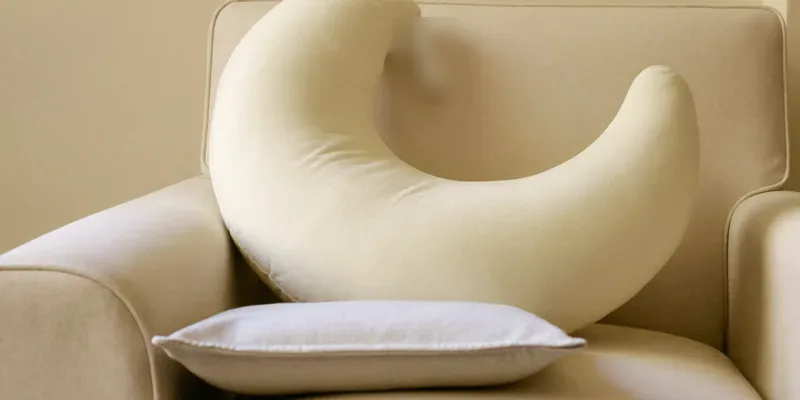
Boppy or the belted kind? The belted kind, in most cases here, because the soft crescent puts the baby’s weight closer to your lap. Full comparison in Boppy against My Brest Friend.
Can I put a pillow over the incision area? Plenty of people describe holding a pillow against the abdomen when moving, and plenty of hospital discharge sheets mention it. Whether it suits your situation is a question for your doctor before you rely on it.
Is it any different for twins? Yes, you need width as well as firmness, and that means a dedicated twin pillow. See feeding pillows for twins.
Can the baby sleep on the pillow while I rest? No. The CPSC has warned about deaths involving nursing pillows used for sleep and lounging, and the AAP advises babies sleep alone on a firm flat surface with nothing else in it.
Does bottle feeding change the answer? Barely. The same firm, high, fastened pillow works, with the baby positioned slightly more upright. See feeding pillows for bottle feeding.
If feeding is painful, if a position is not working, or if you have any question at all about your incision, your movement or how you are doing, talk to your doctor, your midwife or a lactation consultant. A pillow changes the height of a baby and nothing else.
The Bottom Line
Firm, high and fastened is the specification, with something supportive behind your back as the underrated second purchase. Soft cushions put the weight back where you were trying to move it from, adjustable heights solve the leaning problem, and a portable belted pillow suits a period when the best chair keeps changing. Everything about your body belongs with your doctor. Read next: the full feeding pillow guide, and how the wider gear list differs after a C-section.