Last updated: August 23, 2026
Almost everything written about feeding pillows assumes breastfeeding, which leaves a large group of people wondering whether the product is for them at all. It is. The pillows are the same, they are sold under a name that does not describe half their use, and the only real difference is the angle you hold the baby at.
This is the bottle feeding version of the guide: what changes about positioning, which features matter more and which matter less, and the two safety points that apply specifically when a bottle is involved.
This article contains affiliate links. If you buy through them, we may earn a commission at no extra cost to you. Learn more.
Quick Answer
Can you use a nursing pillow for bottle feeding?
- Yes, the same pillows work, and the name is the only thing pointing the other way.
- The baby sits more upright, so a firm surface matters more than a deeply curved one.
- One arm holds the bottle, so arm support on the other side is what you are buying.
- Never prop a bottle and step away, whatever the pillow is doing.
Bottom line: buy the same pillow, use a flatter angle, and keep it strictly to supervised feeding while you are awake.
Why the Same Pillow Works
The pillow’s job does not change with the method. It holds the baby at a height where you are not taking their whole weight in your arms, and it gives your forearms somewhere to rest. That is as useful with a bottle in your hand as it is without one, and arguably more so, since one hand is now occupied.
What does change is the shape of the position. Bottle feeding generally works with the baby a little more upright and their head slightly higher than their body, rather than lying across you. A firm, level surface suits that better than a deep curve, which tends to fold the baby into a position that is harder to feed in.
Best all round starting point
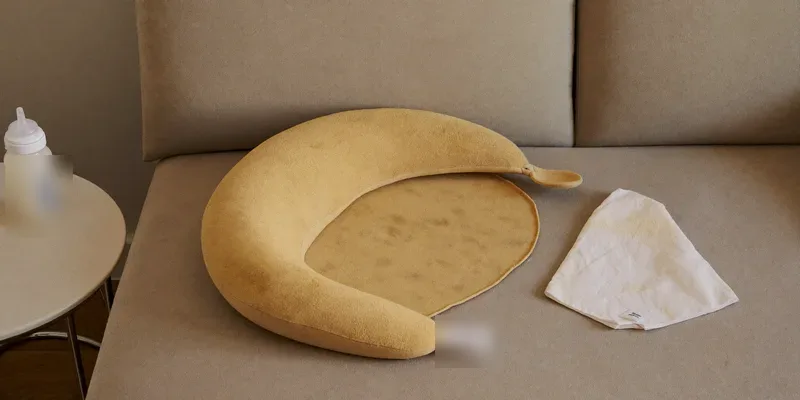
The classic soft crescent is light, easy to put on and off between feeds, and it is the version most people start with regardless of feeding method.

What Matters More, and What Matters Less
Arm support matters more. With one hand on the bottle, the other arm is carrying the baby’s head and shoulders for the length of the feed, and a pillow that supports that forearm is the difference between comfortable and aching. Height matters just as much as it does for breastfeeding.
What matters less is the belt. Fastening is mainly about keeping a shelf perfectly stable at the breast; with a bottle you have more freedom to shift the baby, and plenty of people find an unfastened cushion perfectly adequate. If you already own one, do not assume you need to replace it.
Best if the height has never felt right
An adjustable pillow with removable layers lets you set the baby’s height for a more upright angle, which is the specific adjustment bottle feeding tends to want.

The Position, in Practical Terms
Sit upright with your back supported rather than reclined, put the pillow on your lap and rest your supporting forearm along it. The baby’s head sits in the crook of your elbow or on your forearm, a little higher than their body, facing you. The bottle comes in level rather than tipped steeply, which is the part the pillow height actually controls.
If you find yourself hunching to see the bottle, the pillow is too low. If your shoulder is doing the lifting, it is too high. Those two symptoms are the whole diagnostic, and our positioning guide goes through the adjustments in more detail.
Two Safety Points, Both Non Negotiable
The first is bottle propping. Wedging a bottle against a pillow so the baby can feed without you holding it is a practice the American Academy of Pediatrics advises against, and a feeding pillow makes it look easier than it is. Hold the bottle, every time, and stay with the baby for the whole feed.
The second is sleep. Feeding pillows are for supervised feeding while you are awake and are not sleep products. The Consumer Product Safety Commission has warned about infant deaths involving nursing pillows used for sleep or lounging, and the AAP safe sleep guidance is that babies sleep alone, on their back, on a firm flat surface with nothing else in it. Babies fall asleep during bottle feeds constantly; move them to a safe sleep surface when they do. The full picture is in nursing pillow safety.
Which Shape for Bottle Feeding
| Shape | Bottle feeding fit | Arm support | Worth knowing |
|---|---|---|---|
| Soft crescent | Good, easy on and off | Decent, softens over time | Most versatile around the house |
| Firm belted platform | Very good, level surface | Excellent | More apparatus than most need here |
| Adjustable layered | Very good | Good | Best if standard heights never suit you |
| Small arm cushion | Good for short feeds | Forearm only | Packs into a bag, useful away from home |
All four are supervised feeding products. None of them is a place to leave a baby with a propped bottle, and none of them is a sleep surface.
Feeding Away From Home
Bottle feeding travels more than breastfeeding does, and a full sized pillow does not fit in a bag. A small arm cushion or a compact belted pillow covers the same job for a feed at a friend’s house or in a car park, without committing a large object to the boot of the car.
Plenty of people manage with a rolled up jumper, which works fine. The advantage of a purpose made cushion is that it holds its shape rather than needing rebuilding each time, which matters when you are doing it one handed.
Best for feeds away from home
A compact arm cushion supports the forearm without taking up the whole bag, which is the practical answer when the full sized pillow stays at home.

Frequently Asked Questions
Is there a special bottle feeding pillow? Not really, and you do not need one. The products marketed that way are the same shapes with different packaging. Buy on firmness, height and arm support.
Can I use the pillow to hold the bottle for the baby? No. Bottle propping is a practice the AAP advises against, and it is the one thing a pillow should never be used for. Hold the bottle and stay with the baby.
Do I need the belted kind? Less than a breastfeeding parent does. The belt keeps a shelf precisely stable, which matters less when you can move the baby freely. It is still the firmest option if you want that.
Which one after a C-section? The firm belted design, which keeps the baby’s weight off your lap. See feeding pillows after a C-section.
What about combination feeding? One pillow covers both. Choose on the breastfeeding requirements, since those are the stricter ones, and see the full feeding pillow guide.
Does it help with reflux? That is a question for your pediatrician rather than a shopping decision. Positioning advice around feeding difficulties should come from a professional who can see your baby.
If feeding is not going the way you expected, whether that is the volume, the position or how your baby is settling, a lactation consultant or your pediatrician is the right person to ask. Bottle feeding gets far less hands on support than it should, and asking for it is entirely reasonable.
The Bottom Line
The same pillows work, the angle is slightly more upright, and arm support is what you are really paying for. A soft crescent is a fine default, an adjustable design solves a height that has never suited you, and a compact cushion covers feeds away from home. Hold the bottle, stay with the baby, and never treat the pillow as a sleep surface. Read next: the full feeding pillow guide, and the safety rules in full.