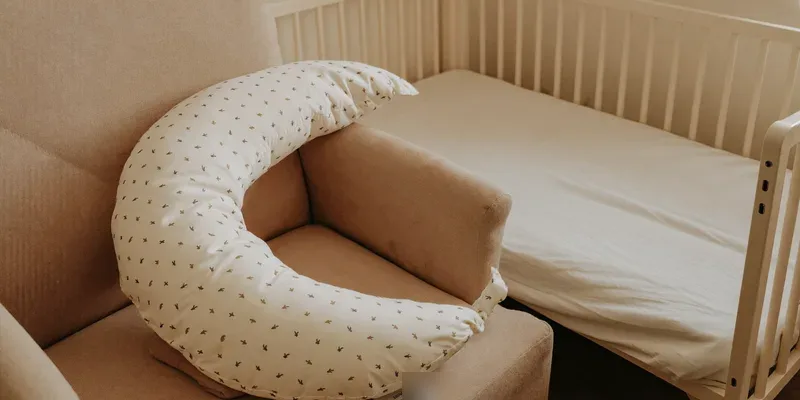
Last updated: August 23, 2026
Nobody buys a nursing pillow planning to let the baby sleep on it. It happens the other way around: the feed goes well, the baby drifts off in the curve of the pillow, everything is finally quiet, and getting up to move a sleeping newborn feels like the worst idea in the world. That moment, repeated at three in the morning by exhausted people, is the whole safety problem in one sentence.
This page sets out what the federal rules and the pediatric guidance actually say, in plain words. There are no product cards here on purpose, because a safety page with something to sell reads differently.
This article contains affiliate links. If you buy through them, we may earn a commission at no extra cost to you. Learn more.
Quick Answer
How do you use a nursing pillow safely?
- Feeding only, with an awake adult holding the baby and paying attention.
- Never for sleep, never for lounging, never left with a baby on it unattended.
- A federal safety standard for nursing pillows took effect in April of 2025, with firmness testing, a ban on restraint straps and a required warning label.
- The AAP’s safe sleep guidance sends a sleeping baby to a flat, firm, separate surface with nothing soft in it.
Bottom line: the pillow is a feeding tool for the adult’s arms, not a place a baby is ever put down.
What a Nursing Pillow Is Actually For
It exists to bring the baby up to you so your shoulders, wrists and back are not doing the lifting for the length of a feed. That is the whole job. It supports the adult more than the baby, and it is designed for a situation in which an alert person has hands on the baby the entire time.
Everything that goes wrong with these pillows comes from the second job they were never designed for: holding a baby who is no longer being fed. The curve that positions a baby beautifully during a feed becomes a shape a baby can slump into, roll within or press a face against once the adult steps away.
Why the Shape Is the Risk
A nursing pillow raises the head and torso and puts soft material on multiple sides. For a newborn without the neck control to move away from an obstruction, that combination is exactly what safe sleep guidance is built to avoid. The pillow is not defective when this happens, it is simply being used for something it is not.
What the CPSC Rule Requires
The Consumer Product Safety Commission approved a mandatory federal safety standard specifically for nursing pillows, and it took effect on April 23, 2025. In broad terms it requires plush surfaces to be tested so they do not conform closely around an infant’s face, it prohibits restraint systems that would strap a baby onto the pillow, and it requires a prominent warning label on the product.
A second CPSC rule covers infant support cushions, which is the category that catches loungers, head positioners, wedges, tummy time pillows and multipurpose pillows marketed for both nursing and lounging. If a product is sold with lounging in its description, that is the rule that applies to it, and the warnings there also cover unattended use and elevated surfaces.
Why the Rule Exists
The CPSC has stated that it is aware of 154 infant fatalities and 88 nonfatal incidents involving nursing pillows over a thirteen year period ending in 2022, with suffocation, entrapment and falls as the mechanisms. That is the agency’s own count, and it is the reason a product most people think of as a cushion now has a federal standard of its own.
What the AAP Safe Sleep Guidance Says
The American Academy of Pediatrics guidance is short and does not have exceptions built into it. A baby sleeps alone, on the back, on a flat and firm surface designed for infant sleep, in a crib, bassinet or play yard, with no pillows, no soft bedding and no positioners of any kind in the space.
A nursing pillow fails that description on nearly every point at once. It is not flat, it is not firm, it is not a sleep surface, and it is usually on a couch or a bed next to an adult. The guidance does not treat a short nap differently from a long one.
The Part People Miss
Falling asleep on a couch or armchair with a baby is singled out in that guidance as one of the riskiest situations. Since the couch is exactly where the nursing pillow lives, feed somewhere you are unlikely to drift off, and move the baby before you settle in yourself.
The Four Habits That Cause Trouble
| Habit | Why it happens | What the guidance says | Safer swap |
|---|---|---|---|
| Leaving baby asleep on the pillow | The feed ended in sleep and nobody wants to wake them | Sleep belongs on a flat, firm, separate surface | Move them across as soon as the feed ends |
| Using it as a lounger | It looks like a supportive nest | Lounging use is covered by warnings, not permitted use | A flat play mat on the floor |
| Stepping away for a moment | The door, the phone, the other child | Never unattended, no exceptions for short absences | Take the baby with you or put them down first |
| Propping it on a couch edge | More comfortable for the adult | Elevated surfaces add a fall risk | Sit back into the seat with both feet down |
Every one of these starts as a convenience for the adult rather than a decision about the baby, which is why the fix is setting yourself up before the feed rather than willpower during it.
Reading the Label Before You Buy
Look for the required warning text and read what the manufacturer says the product is for. A pillow described purely as a feeding support is a different product from one marketed as a lounger or a nest, and that language tells you which rule the maker had in mind.
Be particularly careful with anything that includes a strap, buckle or belt around the baby. Restraint systems are prohibited under the nursing pillow standard, so a strap is a strong signal to look at the listing more closely. Our nursing pillow buying guide works through the shapes and what each one is genuinely good at.
Secondhand Pillows
A pillow made before the federal standard took effect was never tested against it, so the firmness testing and labeling you would expect on a new one may not be there. Check the CPSC recall list for the model before accepting a hand me down.
When Feeds Keep Ending in Sleep
This is normal newborn behavior rather than a discipline problem, and the practical answer is a setup that assumes it will happen. Feed sitting upright in a chair rather than reclined on a couch, keep the crib or bassinet within a few steps, and have the space you will transfer them into ready before you start.
If the pattern is leaving you so tired that you are falling asleep during feeds yourself, or if feeding is taking so long that every session ends this way, that is worth raising rather than absorbing. Speak to your pediatrician or a lactation consultant about what is happening during the feed, because that is the part that changes the pattern.
Frequently Asked Questions
Can my baby nap on the nursing pillow if I am sitting right there? No. Supervision addresses the fall risk but not the suffocation risk from a soft, contoured surface. The AAP guidance puts sleep on a flat, firm, separate surface regardless of who is watching.
Is a firm nursing pillow safe for sleep? Firmness helps during a feed but it does not turn the product into a sleep surface. The federal standard tests plush surfaces so they do not close around a face, and that testing is about reducing harm during intended use, not about permitting sleep.
What about the pillows sold as loungers? Those fall under the infant support cushion rule, which carries its own warnings about unattended use, sleep and elevated surfaces. A product being sold as a lounger is not the same as a product being approved for a sleeping baby.
Do I have to throw away the pillow I already own? Not necessarily. Check it against the CPSC recall list, look at whether it has a restraint strap, and use it only for supervised feeding. Our guide to using a nursing pillow covers the positioning side.
Does any of this apply to bottle feeding? All of it. The risk comes from the pillow and the sleeping baby, not from how the milk arrives. Our page on nursing pillows for bottle feeding covers the positioning differences.
If you have any concern about your baby’s breathing, positioning or feeding, or you are unsure whether a specific product is appropriate, ask your pediatrician or a lactation consultant rather than a product listing.
The Bottom Line
Treat the pillow as equipment for your arms during a feed and nothing else. Awake, supervised, hands on, and the baby moves to a flat firm separate surface the moment the feed is over. Once that line is clear, choosing between shapes is just a comfort decision: our nursing pillow guide covers that, and our postpartum recovery kit covers the rest of what makes those first weeks of feeding easier on you.