Last updated: August 23, 2026
A feeding pillow looks like the simplest purchase in the whole baby aisle, which is why so many people end up with one that does not suit them. The shapes are not interchangeable, the firmness varies far more than the photos suggest, and the single specification that decides whether it works for you is one almost nobody checks: how it sits against your own torso.
This guide sorts the category by how you actually feed rather than by brand. It also says plainly where a pillow is not the answer, because a large share of people get on perfectly well with cushions they already own.
This article contains affiliate links. If you buy through them, we may earn a commission at no extra cost to you. Learn more.
Quick Answer
Which nursing pillow should you buy?
- Firm and belted if you want a stable shelf that stays put and holds its height.
- Soft crescent if you want something versatile that doubles as a prop around the house.
- Adjustable height if you are tall, short, or feeding in several different chairs.
- Wide and flat if you are feeding twins, because a standard pillow is not big enough.
Bottom line: buy for firmness and height first, shape second. And these are supervised feeding products, never sleep surfaces.
What the Pillow Is Actually For
The job is to hold the baby at the height where feeding works without your arms, shoulders and back doing the holding. That is it. Everything that goes wrong with these products goes wrong because the pillow puts the baby too low, sinks under the weight, or slides out of place and needs resetting every few minutes.
Height is therefore the specification that matters, and height depends on your torso as much as on the pillow. A short torso plus a thick pillow lifts the baby too high; a long torso plus a thin one leaves you hunching. This is why the same product gets glowing and furious feedback from people who are both being honest.
Firm beats soft, almost always
A soft pillow compresses under precisely the load you were trying to take off yourself, which means the height on the shelf is not the height you get in use. Owners who switch from a soft pillow to a firm one almost never switch back. Softness is comfortable to lean on and unhelpful to feed on.
The Firm, Belted Kind
This is the flat topped, structured pillow that buckles around the waist. It gives the largest and most stable surface, it does not migrate, and it comes with a back support panel that pulls you upright rather than letting you round forward. If you have shoulder or upper back trouble while feeding, this is the category to look at first.
The trade is bulk and versatility. It is a single purpose object, it takes a moment to strap on, and it is not the thing you casually toss on the sofa. People who love it describe it as the difference between feeding being manageable and not; people who dislike it find it too much apparatus.
Best if your back and shoulders are doing the work
A firm belted pillow with a back support strap holds both the baby and your posture, and it stays exactly where you set it when you stand up and sit down again.

The Soft Crescent Kind
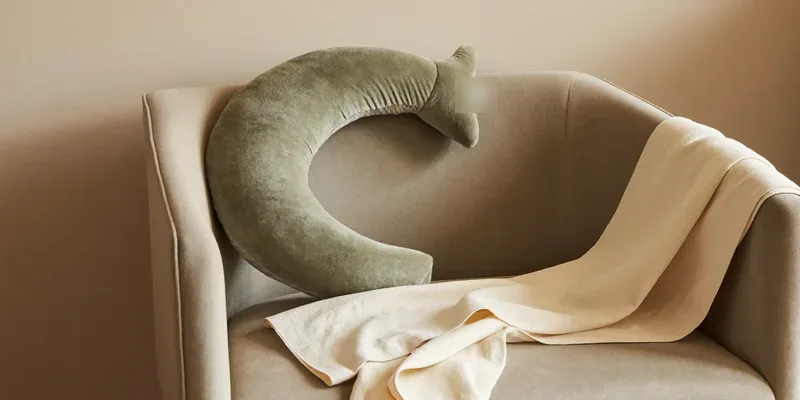
The classic C shaped cushion is softer, lighter and far more versatile. It goes round the waist without fastening, it works in more positions, and it is the one people keep using long after feeding for propping and lounging around the house. It is also the easier one to store and to carry between rooms.
Its weakness is the same as its strength. Without a belt it slides, and with a soft fill it settles under weight, so taller and larger babies flatten it sooner. Many people solve this with a folded blanket underneath, which works and tells you something about the design.
Best if you want one cushion that does several jobs
The classic crescent is the most versatile pillow in the category and the one most likely to still be in use around the house long after feeding is finished.

The Adjustable Kind
A newer group of pillows adds removable layers, a detachable arm rest or an adjustable strap so the height can be tuned. That solves the torso problem directly, which is the most common reason a well reviewed pillow does not work for a particular person.
They are worth a look if you are noticeably tall or short, if you feed in several different chairs, or if you have already tried one pillow and found the height wrong. The added parts mean a slightly fussier product, and covers with more components take longer to put back on after washing.
Best if the standard height has never fitted you
An adjustable pillow with removable layers lets you set the shelf where your body wants it rather than where a fixed cushion puts it.

Twins, and Why a Standard Pillow Will Not Do
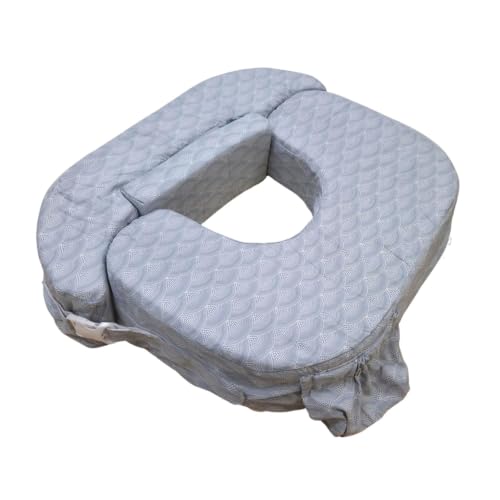
Feeding two at once needs width and a flat, stable surface on both sides, which no standard crescent provides. Twin pillows are wider, flatter and firmer, and they usually fasten, because two babies make a sliding pillow immediately impractical.
They are large, they are difficult to store and they are hard to justify for a single baby. If twins are the situation, though, this is one of the few pieces of gear in this category that genuinely has no substitute. Full detail in our twin feeding pillow guide.
Best for tandem feeding
A wide, flat twin pillow gives a stable surface on both sides at once, which is the only arrangement that makes tandem feeding workable without a second pair of hands.
Safe Use, Every Time
Feeding pillows are for supervised feeding while you are awake, and they are not sleep products. The Consumer Product Safety Commission has warned about infant deaths involving nursing pillows used for sleep or lounging, and the American Academy of Pediatrics safe sleep guidance is that babies sleep alone, on their back, on a firm flat surface with nothing else in it.
In practice that means three rules: never put a baby down to sleep on or against a feeding pillow, never leave a baby unattended on one, and move the baby to a safe sleep surface if they fall asleep during a feed. Our nursing pillow safety article sets out what the two organizations actually say.
The Shapes Side by Side
| Type | Firmness | Back support | Suits you if |
|---|---|---|---|
| Firm belted | Very firm, flat top | Yes, wraparound panel | Your back and shoulders ache while feeding |
| Soft crescent | Soft, curved | No | You want versatility and easy storage |
| Adjustable | Medium, layered | Sometimes | Standard heights have never suited you |
| Twin pillow | Firm, wide and flat | Usually a strap | You are feeding two at once |
All four are supervised feeding products. None of them is a sleep surface, whatever the lifestyle photography on a listing suggests.
Covers, Washing and the Boring Details
Whatever you buy will be spilled on within the week, so a removable, machine washable cover is not optional. Check whether the cover you can see is the only one or an extra over a plain inner, since the two arrangements wash very differently and only one of them lets you keep using the pillow while the cover dries.
A second cover is the cheapest useful accessory in this whole category. Sizing between brands is not interchangeable, which trips people up when they buy a spare; see covers and spares before ordering one.
You May Not Need One At All
Search interest in this category has been falling for years, and that is not an accident. Plenty of people feed comfortably with an ordinary cushion under the elbow, and plenty of well reviewed pillows are quietly abandoned after a fortnight. Buying one is reasonable; assuming it is compulsory is not.
If you want to test the idea before spending, try a firm ordinary pillow under your arm at the height you think you want. We compare that approach directly in feeding pillow against a regular pillow, and weigh up the whole question in do you need one.
Frequently Asked Questions
Boppy or My Brest Friend? Firm shelf and back support against soft versatility. If posture is your problem, take the belted one; if you want a cushion that does other jobs, take the crescent. Full comparison in Boppy against My Brest Friend.
Can the baby nap on it while I sit next to them? No. Feeding pillows are not sleep surfaces, the CPSC has warned about deaths involving their use for sleep and lounging, and the AAP advises babies sleep alone on a firm flat surface with nothing else in it.
Does it work for bottle feeding? Yes, and the same pillows are used for it. The positioning differs slightly, which we cover in feeding pillows for bottle feeding.
Which one after a C-section? The firmer belted designs, because they carry the baby’s weight rather than resting it in your lap. See feeding pillows after a C-section.
I am tall. Will a standard pillow be too low? Often, yes, and that is the most common reason a highly rated pillow disappoints. Look at the adjustable designs, or plan to add a folded blanket underneath.
Is it worth buying before the birth? One is enough to start with, and you can order a different shape later if it does not suit you. Buying two in advance is the classic over purchase here.
If feeding is painful, if positioning is not working, or if you are worried about how it is going, a lactation consultant will get you further than any pillow will. That is the referral worth making early rather than late.
The Bottom Line
Buy for firmness and height before you think about shape: a firm belted pillow if your back and shoulders are the problem, a soft crescent if you want versatility, an adjustable one if standard heights have never fitted you, and a wide flat one for twins. Get a spare cover, treat it strictly as a supervised feeding product, and be open to the possibility that a cushion you already own does the job. Read next: the safety rules in full, and how to position one.