Last updated: August 23, 2026
Raspberry leaf tea occupies a strange position in late pregnancy. It is recommended constantly in forums and by friends, it is sold in every health food aisle with pregnancy on the box, and the confident advice about when and how much to drink varies wildly depending on who you ask.
This page sets out what is actually known, what is claimed, and why we do not recommend it or sell it. It is the only page on this site about anything you drink for an effect, and it exists because the question is unavoidable rather than because we have an answer.
This article contains affiliate links. If you buy through them, we may earn a commission at no extra cost to you. Learn more.
Quick Answer
What is known about raspberry leaf tea in pregnancy?
- It is a herbal infusion made from the leaf, not the fruit, and it is not a medicine.
- The research that exists is limited in size and quality, and it does not settle the question either way.
- There is no agreed point in pregnancy at which it is recommended to start, which is why the advice you hear differs so much.
- Herbal products are regulated as supplements in the US, so the strength of what is in the box varies between brands.
Bottom line: ask your midwife or OB-GYN before drinking it, and treat confident internet answers as opinion.
What It Is
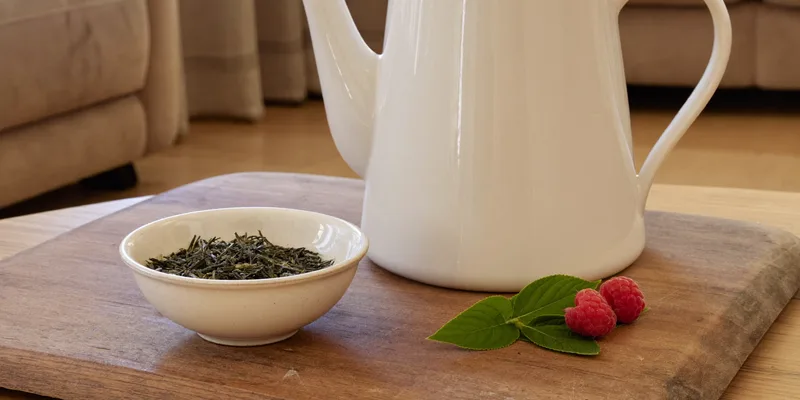
Raspberry leaf tea is an infusion of the leaves of the raspberry plant, which is a different thing from raspberry flavored tea made with fruit. It has a long history of traditional use around childbirth in several cultures, and that history is the origin of nearly everything said about it today.
Traditional use is a real thing and it is not evidence of effect. It tells you that people have done this for a long time, which is worth knowing and is not the same as knowing what it does.
Why It Is Everywhere
Because it sits at the intersection of a widely shared belief, an inexpensive product and a moment in pregnancy where many people are looking for something they can do. That combination sells a great deal of tea.
What Is Actually Claimed
The claims cluster around late pregnancy and the birth itself: that it tones the uterus, that it shortens the second stage, that it reduces the chance of certain interventions. These are the claims as they are made by others, and we are describing them here rather than repeating them as fact.
Notice that the claims are about outcomes nobody can observe in themselves. That is what makes the belief so durable, because there is no personal experiment that could tell you whether it did anything.
What the Evidence Shows
Very little, in both directions. The studies that exist are few, small and varied in design, which is a description researchers themselves use about herbal preparations in pregnancy. Reviews of this literature consistently conclude that the evidence base is not strong enough to support firm conclusions.
The National Center for Complementary and Integrative Health’s general position on herbal products is that many of them have simply not been studied in pregnancy, and that a long history of use does not establish safety. That applies here as much as anywhere.
What Absence of Evidence Means
It does not mean the tea does nothing, and it does not mean it is harmful. It means nobody can tell you with confidence which of those is true, and that anyone speaking confidently about it is going beyond what is known.
Why There Is No Agreement About Timing
Because there is no established recommendation to disagree about. Advice about when to start and how much to drink circulates through forums, herbalists, individual midwives and product packaging, and those sources do not agree with each other because none of them is drawing on a settled guideline.
We deliberately do not name a week or a quantity here. Publishing a schedule would imply a recommendation we cannot support, and it would be repeating internet consensus rather than evidence.
The Regulatory Picture
In the United States, herbal teas and supplements are regulated as dietary supplements rather than as medicines. The FDA does not review them for safety and effectiveness before they are sold, and manufacturers are responsible for their own labeling.
Practically, that means the amount of plant material per bag, the part of the plant used and any blending with other herbs vary between products. Two boxes with the same name on the front are not necessarily the same thing.
Blends Are the Part to Read
Many products marketed for pregnancy are blends containing several herbs. Each additional ingredient is another thing to ask about, and the ingredient list is the only place that information appears.
Claims Against What Is Established
| What is said | Basis for it | How strong that is | Our position |
|---|---|---|---|
| Long traditional use | History and custom | Real, but not evidence of effect | We report it as history |
| Effects on labor | A few small studies | Limited and inconsistent | We make no claim |
| A specific week to start | Forums and packaging | No established guideline | We name no week |
| Safe because it is natural | Assumption | Not how safety is established | Ask a provider |
| All brands are equivalent | Assumption | Contents vary by product | Read the ingredient list |
What to Ask Instead
Bring the box to an appointment and ask directly: given your history, your medications and how your pregnancy is going, does your provider have a view on you drinking it. That question has an answer. The general question does not.
It is worth asking early rather than in the last weeks, when the pressure to try things is highest and appointments are busiest. If you are looking at other things people try at home, our page on what to know before trying anything at home takes the same position for the same reasons.
Frequently Asked Questions
Is raspberry leaf tea safe in pregnancy? That is a question for your midwife or OB-GYN, and it depends on your history and anything else you take. We are not able to answer it, and neither is a box of tea.
Does it work? The available research is limited and does not settle it. Anyone telling you plainly that it does or does not is going further than the evidence goes.
When do people start drinking it? Advice varies widely and there is no agreed point, which is precisely why we do not publish one. Ask your provider if you want a view that applies to you.
Is the fruit tea in my cupboard the same thing? No. Raspberry flavored tea and raspberry leaf tea are different products, and the ingredient list is where you check.
Why does this site not sell it? Because we do not recommend anything you swallow, and recommending it would mean taking a position that the evidence does not support.
What about other pregnancy teas? Same answer, and the same conversation. Blends contain several herbs, each of which is a separate question for your provider.
Before you drink raspberry leaf tea or any herbal preparation during pregnancy, ask your midwife, your OB-GYN or your pharmacist. They are the only people who can weigh it against your own situation.
The Bottom Line
There is a long tradition, a small and inconclusive body of research, no agreed timing, and no regulatory review of what is in the box. That is the honest summary, and the next step is an appointment rather than a purchase. Read next: birthing balls and what they are actually for, the hospital bag checklist and the books worth reading before birth.