Last updated: August 23, 2026
The pregnancy pillow is the one big purchase of the third trimester that people assume has a hard expiry date. The bump goes, the reason to own a five foot horseshoe goes with it, and the pillow ends up folded into a closet within a fortnight. That is a waste, because the first weeks at home involve a great deal of sitting still in awkward positions.
It does need a change of job, and one important boundary. A pregnancy pillow is adult equipment. It supports you, not the baby, and the difference matters enough that it gets its own section below. With that clear, here is what the pillow is genuinely good for once the pregnancy is over.
This article contains affiliate links. If you buy through them, we may earn a commission at no extra cost to you. Learn more.
Quick Answer
What do you do with a pregnancy pillow after birth?
- Use it as adult back and arm support in the chair or corner of the bed where you feed.
- Keep the wedge nearest to hand, since it is the piece that works on a couch and in a car.
- Do not use it as a surface for the baby to lie or sleep on, which is the one hard rule.
- Wash the cover, air the core, and store it flat rather than compressed if you want it for next time.
Bottom line: it becomes furniture for you, not equipment for the baby.
The Safety Boundary First
A pregnancy pillow is not a baby product, and it should not be used as one. The CPSC has warned about the risk of infant deaths associated with nursing pillows and pillow like products when babies are left on them, and the AAP’s safe sleep guidance is that babies sleep alone, on their back, on a firm flat surface with nothing soft around them.
In practice that means the pillow can be behind your back and under your arms while you hold the baby, and the baby is never left lying on it, never left on it unattended, and never put to sleep on it. Our guide to nursing pillow safety sets out the full picture, and it is worth reading once.
Back Support Where You Feed
The single most useful post birth job is filling the gap behind your lower back in whatever chair or corner of the sofa you end up feeding in. Household furniture is not built for sitting still with your arms forward for long stretches, and that is where the ache comes from.
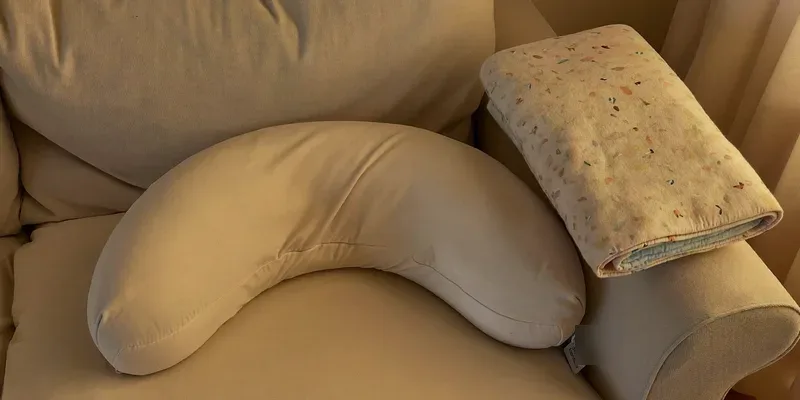
A C shape works well here because the curve wraps around one side of you, and a wedge works even better in a chair with a shallow seat. Set it up once and leave it there rather than carrying the pillow around the house.
Arm Support Is the Part People Forget
Holding a baby means holding your own arms up, and that is what gives out first. A rolled section of the pillow under the supporting forearm changes the whole position. If your shoulders are the thing complaining, that is the adjustment to make.

Where a Real Feeding Pillow Does It Better
A pregnancy pillow supports you; a nursing pillow is shaped to bring the baby up to a workable height. Those are different jobs, and improvising the second with the first usually ends with a stack of pillows that slides at the worst moment. If feeding is uncomfortable, the dedicated product is the better answer.
The same safety rules apply to feeding pillows, and they are only used while you are awake and holding the baby. Our nursing pillow guide covers the shapes, and the Boppy and My Brest Friend comparison covers the two names you will see most.

Recovery Positions and Sitting
Sitting is uncomfortable for a while after any birth, and a support pillow helps in the ordinary furniture sense: propping you at an angle that takes weight off the spot that hurts, or supporting your side when lying down is the only tolerable option. After a C-section, a firm wedge held against the abdomen is the prop many people use when getting up or moving.
None of this is a treatment and none of it replaces the guidance you were given at discharge. What is normal for your recovery, and what is not, is a question for your midwife, your OB-GYN or a pelvic floor physical therapist. Our postpartum recovery kit guide covers the gear side of the first weeks.
Second Lives by Shape
| Shape | Best second job | Where it lives | Note |
|---|---|---|---|
| Wedge | Back or arm prop, car and couch | Wherever you sit | The most portable piece |
| C shape | Wrap around support in a chair | The feeding chair | Set it up and leave it |
| U shape | Bed nest for the adult | Your side of the bed | Too big for most chairs |
| Straight body pillow | Behind the back, under the arm | Sofa or chair | Easiest to reposition |
Every row assumes the pillow is supporting an adult. None of these arrangements involves the baby resting on the pillow, for the reasons in nursing pillow safety.
Storing It for Next Time
If there might be a next pregnancy, how you store the pillow decides whether it is usable. Wash the cover, air the core until it is completely dry, and store it loosely rather than vacuum compressed. Fill that has been crushed flat for a year does not fully recover, particularly loose fiberfill.
A large bag in a dry cupboard is fine. A damp basement is not, and a compression sack is the thing that most often ruins a pillow in storage. Our washing guide covers getting it clean before it goes away, and a fresh replacement cover makes it feel new when it comes back out.

When to Let It Go
If the fill has compressed evenly, if the shell has stretched so the fill wanders, or if the pillow has been soaked at any point, it has reached the end. Passing on a pillow in that state to a friend is not much of a favor, and neither is storing it for a pregnancy that may be years away.
Charitable donation rules vary by organization and by state, and many will not take used pillows at all, so check before you drive across town with one. Textile recycling is the usual alternative.
Frequently Asked Questions
Can the baby sleep on my pregnancy pillow? No. The CPSC has warned about infant deaths linked to nursing pillows and similar products, and the AAP’s safe sleep guidance is a firm flat surface with nothing soft around the baby. The pillow supports you only.
Can I use it instead of buying a nursing pillow? You can use it as your own back and arm support, which helps a lot. Bringing the baby to a workable height is a different job, and the nursing pillow guide covers the products built for it.
Is it useful after a C-section? Many people use a firm wedge as a prop when sitting up and moving around. Follow the guidance you were given at discharge, and see pregnancy pillows after a C-section for the positions.
How should I store it between pregnancies? Clean cover, fully dry core, stored loose rather than compressed, in a dry cupboard. Compression is what ruins a stored pillow.
Will it still be good for a second pregnancy? If the fill held up and it was stored well, yes. If it had already gone flat, read why pregnancy pillows lose their shape before deciding to keep it.
Can I use it on the couch during the day? Yes, and a wedge is far more practical for that than a full body shape. Many people keep the wedge downstairs and the big pillow upstairs.
The Bottom Line
Give the pillow a new job as adult support in the place where you sit and feed, keep the wedge closest to hand, and never let it become a surface the baby rests on. If feeding is painful, if sitting is not getting easier, or if you are unsure what is normal for your recovery, raise it with your midwife, your OB-GYN or a lactation consultant rather than solving it with cushions. Read next: the nursing pillow guide, and the postpartum recovery kit for the rest of the first weeks.