Last updated: August 23, 2026
Postpartum shopping lists are written as one long inventory, which is not how the period is experienced. Things become useful in a rough order: what you want in the bathroom on the first night is not what you want on the sofa in the second week, and the item that seemed pointless in the box turns out to be the one you carry from room to room.
This is that list arranged by when things come into play instead of by category. No recovery timeline is implied and none should be read into it. How long anything takes is different for every person and belongs with your midwife or doctor, not with a gear guide.
This article contains affiliate links. If you buy through them, we may earn a commission at no extra cost to you. Learn more.
Quick Answer
What gear do you actually reach for in the first two weeks?
- First: bathroom supplies, absorbent underwear and a water bottle you can open one handed.
- Then: somewhere comfortable to sit and feed, and pillows in more than one room.
- Then: clothes that open at the front and shoes you do not have to bend for.
- Later: whatever makes leaving the house possible, which is a surprisingly short list.
Bottom line: buy for the bathroom and the sofa first. Everything else can be ordered once you know what you are missing.
Set Up Two Stations Before Anything Else
The single most useful piece of preparation is not a product, it is a layout. Put a supply station in the bathroom you will use most and a second one wherever you will end up feeding, and stock both before the birth. Getting up to fetch something is the thing you are trying to design out.
The bathroom station holds the rinsing bottle, the pads or liners, the underwear and whatever cold or soothing item you have chosen. The sitting station holds water, snacks, phone charger, burp cloths and something to prop your arms on. A basket or caddy for each keeps them from spreading.
The one thing to buy for both stations
A large insulated bottle with a straw and a handle can be opened, carried and drunk from with one hand and a baby in the other, which is why it appears in every honest version of this list.

The First Days: The Bathroom Runs Everything
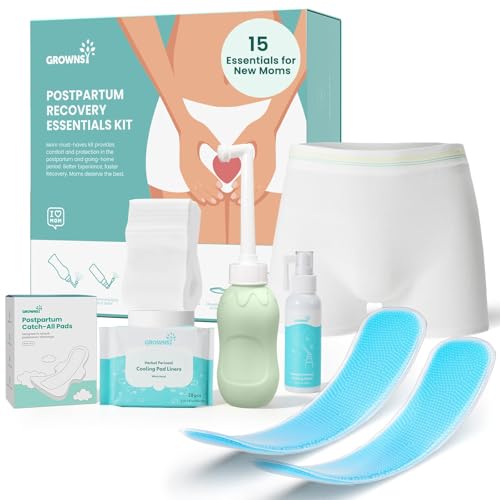
Early on, almost every item you reach for lives in the bathroom. A rinsing bottle you can aim, absorbent underwear, heavy pads or liners, and something cold if that appeals. Hospitals commonly send you home with a starter supply of several of these, so check what you have before opening a second box.
Two practical notes from owner feedback: buy more underwear than feels reasonable, and put a spare set of everything in a second bathroom if you have one. The stairs are the enemy of a well planned single station.
Best if you want it all in one order
A prebuilt recovery kit covers the bathroom station in one delivery, which is the point at which most people stop researching and start packing.
The First Nights: Getting In and Out of Bed
Sleep is broken into fragments and the equipment that matters is whatever makes the transitions less effortful. A firm wedge or a stack of pillows behind the back turns sitting up from a flat start into a partial one. A dim lamp or a nightlight means not turning on the overhead light at every feed.
If you already own a pregnancy pillow, keep it. It is more useful now than most people expect, as a back prop, a knee spacer and an arm rest while feeding. Our guide to using a pregnancy pillow after birth covers the repositioning.
Feeding Gear, Whichever Way You Are Feeding
Feeding is what the middle of this period is made of, and the gear question is the same whether there is a bottle involved or not: support the arms, support the back, keep the baby’s weight off the lap. A feeding pillow does all three, and a footstool fixes the posture problem a pillow cannot.
Firmness is the specification that matters most. Soft pillows compress under exactly the load you were trying to take off your arms, which is why the firmer belted designs get recommended so consistently. Our feeding pillow guide works through the shapes.
Best if your arms and shoulders are doing the work
A firm feeding pillow with a fastening strap stays in position instead of sliding down, which matters when standing up to readjust is the thing you are avoiding.

Safe use, every time
Feeding pillows are for supervised feeding while you are awake and are not sleep products. The Consumer Product Safety Commission has warned about infant deaths involving nursing pillows used for sleep or lounging, and the American Academy of Pediatrics safe sleep guidance is that babies sleep alone, on their back, on a firm flat surface with nothing else in it. Never leave a baby unattended on a feeding pillow. The full picture is in nursing pillow safety.
Clothes: Front Opening, Soft Waistbands, No Bending
Clothing becomes a gear question quickly. Anything that pulls over the head is inconvenient if you are feeding, anything with a firm waistband is uncomfortable across the middle, and anything that needs bending to put on is out of the question early on. Front opening tops, soft high waisted bottoms and slip on shoes cover almost everything.
Most people wear a mix of late maternity clothes and roomy loungewear rather than buying a new wardrobe, which is the sensible approach. If you want one purchase, make it a soft high waisted legging that does not sit on the middle of the abdomen; see postpartum leggings for the gentler options.
What Comes Into Play When, Roughly
| Stage | What matters | Where it lives | Easy to get wrong |
|---|---|---|---|
| Coming home | Bathroom supplies, underwear | Bathroom caddy | Buying less than you need |
| The first nights | Propping, dim light | Bedside | Overhead lights at every feed |
| Settling in | Feeding support, water, snacks | Sitting station | Soft pillows that collapse |
| Getting dressed again | Front opening tops, soft waists | Wardrobe | Buying a whole new wardrobe |
| Leaving the house | Bag, slip on shoes, spares | By the door | Packing far too much |
The stages are a sequence, not a schedule. People move through them at completely different speeds and there is no correct pace to compare yourself with.
What Sits Unused
The pattern in owner feedback is consistent. Specialist gadgets, duplicate versions of what the hospital supplied, and anything that requires a setup step tend to stay in the box. The items that get used are boring, are within arm’s reach, and were bought in a large enough quantity.
The other unused category is anything bought for a version of this period that does not arrive. Buy the shared basics, wait, then order the rest. The delivery still comes, and someone will bring it upstairs.
Frequently Asked Questions
How much of each consumable should I have ready? Enough that you are not reordering in the first days, and a saved cart for when you do. Exact amounts vary far too much between people for a number here to mean anything.
Do I need a special chair? No, but a chair with arms at the right height and a footstool makes feeding considerably easier than a sofa does. See chairs and footstools.
What is the most underrated purchase? The water bottle, consistently. After that, a second set of bathroom supplies upstairs, and a small nightlight.
Does this list change after a C-section? Yes, in the middle section. High waisted underwear, something to hug when coughing and a firm wedge for getting upright move to the top. We split it in two lists by birth type.
When do I stop needing all of this? That varies enormously and is not a gear question. Your midwife, doctor or a pelvic floor physical therapist can tell you what to expect for you.
Everything above is comfort equipment. If you are in pain, if something does not feel right, or if you are unsure whether what you are experiencing is ordinary, contact your midwife or doctor rather than searching for a product that might address it.
The Bottom Line
Set up a bathroom station and a sitting station before the birth, stock both more heavily than feels necessary, and let everything else wait until you know what you are missing. The items people rate highest are ordinary ones kept within reach, and the ones that stay in the box are the clever ones bought in advance. Read next: the full recovery kit list, and how to choose a feeding pillow.