Last updated: August 23, 2026
You get the flanges in, get the pump running, reach for your coffee, and one side tips forward and breaks the seal. You push it back. Two minutes later the other one goes. By the end of the session you have been holding the flanges anyway, which was the exact thing the bra was supposed to prevent.
This is the most repeated complaint in the whole pumping bra category, and it is not a rare defect. The best selling hands free pumping bras on Amazon collect thousands of positive reviews and a steady stream of one star reviews saying the same sentence in different words, and the top seller of the lot carries the lowest average rating of the leading models for precisely this reason. Here is why it happens and what actually fixes it.
This article contains affiliate links. If you buy through them, we may earn a commission at no extra cost to you. Learn more.
Quick Answer
Why does my pumping bra not hold my flanges?
- The opening is too large for your flange, or the fabric around it has stretched, so nothing grips the rim.
- The band is too loose. A pumping bra holds by tension across the front, and a loose band cannot generate any.
- The flange is heavy at the end of a session, especially with bottles attached, and weight pulls it outward and down.
- Wearable pumps need cup depth and a firm band, not an opening, so a cut out bra will never hold one properly.
Bottom line: tighten the band first, switch to collection bags or a strapless band second, and change bras only after those two.
Start With the Free Checks
Before buying anything, work through three adjustments that cost nothing. Tighten the band to the smallest comfortable setting, sit upright rather than leaning back, and empty or swap the bottles part way through a long session. Those three between them solve a surprising share of flange drift.
Posture matters more than it sounds. Reclining tilts the whole front panel away from vertical, so gravity works on the flange sideways instead of along the body. Sitting up straight, or leaning very slightly forward, keeps the flange pressed where the bra is holding it.
Weight Is the Hidden Variable
An empty flange with a bottle is light. The same assembly at the end of a session is not, and the bra has to hold more than it did at the start. Switching to lightweight collection bags, or to smaller bottles emptied more often, changes the load without changing the bra.
Why the Opening Is the Problem
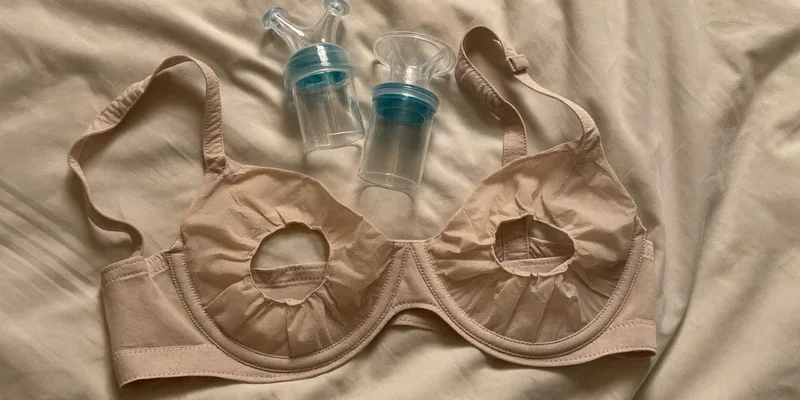
Most pumping bras use a slit or a small hole in a stretch panel, sized around a common flange diameter. If your flange is narrower than that opening, the fabric has nothing to grip and the flange sits in a hole instead of being held by one. If it is wider, the fabric stretches permanently and never grips again.
That is why one person raves about a bra and the next returns it. They are describing the same garment with different hardware in it. The fix is either an opening that closes around the flange under tension, or a design with no opening at all that presses the whole assembly against the body.
What Holds, by Pump Type
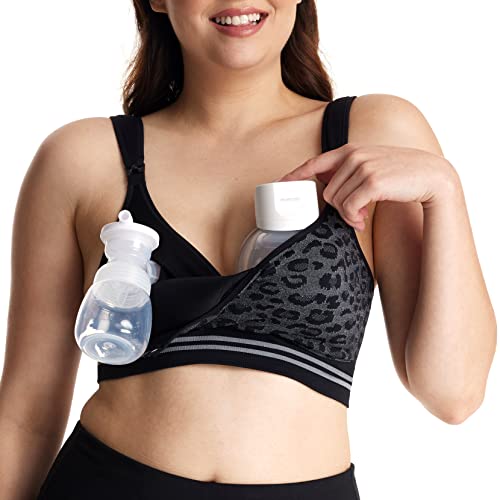
Pumps fall into three groups for this purpose, and the group decides the bra. Standard flange pumps connected by tubing, closed system pumps with heavier collection kits, and wearable pumps that sit entirely inside the cup. The picks below follow that split.
If you use a standard flange pump with tubing
Spectra, Medela and Lansinoh style kits are what most all in one pumping bras are designed around, and a bra with a reinforced crossover front holds them well as long as the band is snug. Look for a structured panel rather than a plain stretch knit with a hole cut in it.

If nothing has held so far
A strapless pumping band that goes over your own bra is the design people move to when all in one bras have failed them. It closes with a wide hook and loop back panel, so the tension is set by you rather than by the fabric, and it can be tightened again as it wears. It takes a minute to put on, which is the entire downside.

If you use a wearable pump
Elvie and Willow style pumps have no external flange to hold, so an opening is useless and a deep, firm cup is everything. A seamless pumping bra with fixed padding and a snug band keeps the device upright and against the body as it fills, which is when wearable pumps most often start to leak.
If the flange itself is the wrong size
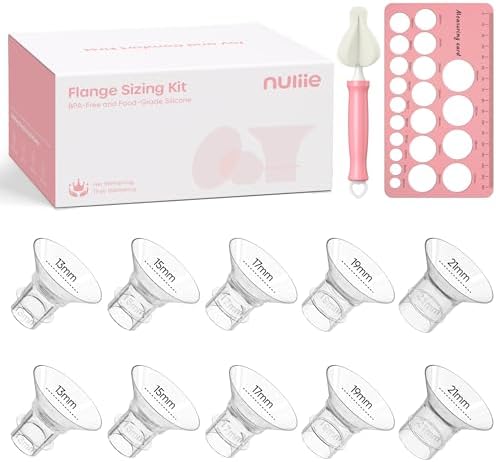
A flange that does not match you will feel wrong no matter what bra holds it, and inserts are the cheap way to change the diameter without replacing the kit. Sizing a flange to your own anatomy is not a guessing game worth playing alone, so ask a lactation consultant to look at the fit before you buy a set of everything.
Which Bra for Which Pump
| Pump style | What the bra must do | Best construction | Common failure |
|---|---|---|---|
| Standard flange with tubing | Grip the flange rim under tension | All in one with crossover panel | Opening stretched out |
| Heavier closed system kit | Carry weight as bottles fill | Strapless adjustable band | Flange tips forward late in a session |
| Wearable in cup pump | Hold a deep device upright | Seamless firm cup, no opening | Device slides and leaks |
| Mixed, pump and feed | Both clips and openings | All in one, structured front | Compromises on both jobs |
Whatever your pump, test the combination at home with water in the bottles before you rely on it at work.
When the Bra Is Not the Problem
If pumping is uncomfortable, if the seal fails on one side only, or if output changes noticeably without an obvious reason, the flange size or the pump settings are the more likely explanation than the bra. Bras hold hardware in place; they do not change how the hardware fits you.
A lactation consultant can check flange sizing and technique in a single appointment, and that is the right place to take those questions rather than a product listing. If you have soreness, damaged skin or persistent pain while pumping, speak with a lactation consultant or your doctor before changing anything else.
Frequently Asked Questions
Why do flanges fall out of the most popular bras? Because a single opening size has to serve a wide range of flange diameters, and it grips only the ones near the middle of that range. The bras are not badly made, they are generically sized, and the reviews split along exactly that line.
Will a smaller bra size fix it? Often yes, and it is the cheapest thing to try. Pumping bras hold by tension, so a snug band does more than any feature on the listing. This is the one bra category where sizing down is reasonable advice.
Do strapless pumping bands really hold better? They hold better because you set the tension yourself with a wide adjustable closure, and you can retighten it as the fabric ages. The cost is that you put it on over your existing bra, which takes an extra minute.
Can I use a pumping bra with a wearable pump? Only one designed for it. A bra with cut outs has nothing to hold a cup shaped pump, and the pump slides as it fills. Look for a deep seamless cup and a firm band instead.
My bra held fine and now it does not. What changed? Usually the fabric. Stretch panels lose their grip after repeated washing and repeated stretching around a rigid rim, and there is no way back. Wash cool, air dry, and treat pumping bras as a wear item. Our pumping bra guide covers which constructions last longest.
Should I buy one bra for feeding and one for pumping? If you do both regularly, yes. An all in one is a genuine convenience and a genuine compromise, and people who pump a lot usually end up with a dedicated band as well. See hands free pumping bras for the comparison.
The Bottom Line
Tighten the band, sit upright and lighten the load before you buy anything, then match the construction to your pump: a structured all in one for standard flanges, a strapless adjustable band when nothing else has held, and a deep seamless cup for wearable pumps. If the fit of the flange itself is in question, that is a conversation with a lactation consultant rather than a shopping decision. Read next: the full pumping bra guide and how nursing bras differ.