Last updated: August 23, 2026
The first time you pump without a pumping bra, the problem announces itself immediately. Both hands are holding flanges against your chest, the phone is out of reach, and there is nothing to do for the length of the session except sit very still. Do that twice a day and the appeal of a bra that holds the flanges for you becomes obvious.
What is less obvious is that a pumping bra has a completely different job from a nursing bra. A nursing bra holds a breast. A pumping bra holds a piece of hard plastic at a precise angle against a breast, without letting it drift, for the whole session. Those are different engineering problems, and buying the wrong one is the most common mistake in this category.
This article contains affiliate links. If you buy through them, we may earn a commission at no extra cost to you. Learn more.
Quick Answer
Which pumping bra should you buy?
- If you pump a few times a day and want one garment, buy an all in one pumping and nursing bra with a firm front panel.
- If you pump exclusively or for long sessions, a dedicated strapless band that goes over your own bra holds flanges more securely than any hybrid.
- If you use a wearable pump, you need cup depth and a snug band rather than flange slots, and not every pumping bra offers that.
- Buy for the pump you own. Flange diameter and pump weight decide the fit more than your bra size does.
Bottom line: match the bra to the pump first and to your wardrobe second, because a bra that lets the flange drift wastes the whole session.
What a Pumping Bra Has to Do
A pumping bra has one mechanical task: keep the flange pressed at a steady angle against the breast so the seal holds. If the flange tips, slides down or rotates, suction drops and the session produces less for the same amount of time. Everything about the construction serves that one job.
That is why the good ones feel firmer than a normal bra. A stretchy knit lets the flange travel; a dense panel with a small reinforced opening does not. Comfort still matters, but it is comfort under tension rather than the soft comfort of a sleep bra.
The Three Types
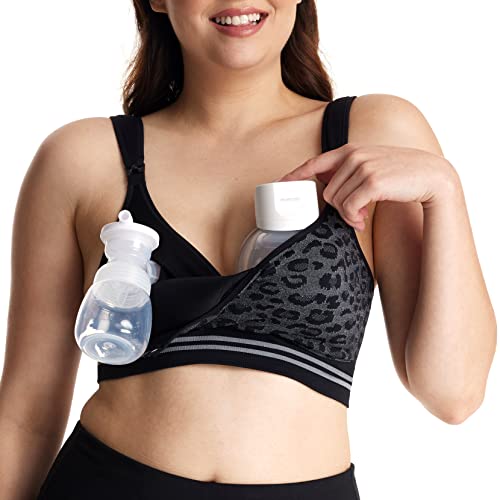
Pumping bras come in three constructions and they suit different routines. All in one bras combine nursing clips and pump openings in one garment. Strapless bands go over the bra you are already wearing. Wearable pump bras have no openings at all and instead hold a cup shaped pump against the body.
Each type trades convenience against grip. An all in one is what you can wear all day; a strapless band is what holds best; a wearable pump bra is a different product that happens to share the name. Choose from your routine, not from the product title.
All in One or Over the Top
The practical difference is whether you have to change garments to pump. An all in one lets you unclip, insert the flanges and start, which matters if you pump at work between meetings. A strapless band means putting something on over your bra, which takes a minute and holds noticeably better.
Pumping Bras by Situation
The four picks below cover the routines people actually have. Read the flange section further down before ordering, because pump compatibility rules out more options than size does.
Best if you pump a few times a day and want one bra
An all in one pumping and nursing bra has clips for feeding and openings for flanges in the same garment, so you can go from a feed to a pump without changing. Look for a firm center panel and an X shaped or crossover structure at the front, which is what stops the flange from tipping outward.

Best if you pump for long sessions or exclusively
A dedicated strapless pumping band wraps over your own nursing bra and closes with a wide adjustable back panel, which is the firmest hold available and the reason this design has lasted so long. It also fits a wide size range, since the closure does the adjusting rather than the fabric.

Best if you want a pumping bra you can wear to work
Some pumping bras are built with molded cups and a smooth outer surface so they look like an ordinary t shirt bra under clothes, with the pump openings hidden in the seam. They hold slightly less firmly than a dedicated band and save you a change of clothes at the office.

Best if you use a wearable pump
Wearable pumps sit inside the cup rather than through an opening, so what you need is depth, a snug band and enough fabric tension to hold a device that gets heavier as it fills. A seamless pumping bra with fixed padding and a firm band suits this better than any bra with cut outs in it.
The Four Types Compared
| Type | How it holds | Also a nursing bra | Suits |
|---|---|---|---|
| All in one | Reinforced front panel with openings | Yes, clips included | A few sessions a day |
| Strapless band | Wide adjustable back closure | No, goes over your bra | Long or exclusive pumping |
| Molded cup pumping bra | Structured cup, hidden openings | Usually yes | Workdays, fitted clothes |
| Wearable pump bra | Deep cup and snug band | Sometimes | Cup shaped pumps |
Whichever type you pick, try it with your own flanges attached and the pump running before you decide it fits.
Flange Fit Is the Whole Game
Flanges come in different diameters and different shapes depending on the pump, and a bra opening that suits one brand can be too loose for another. A loose opening lets the flange rotate, which breaks the seal quietly rather than obviously, and the first sign is usually a session that produced less than usual.
This is the single most common complaint in pumping bra reviews and it deserves its own article, which is why we wrote one. Our guide to pumping bras and flange fit sorts the options by pump brand and covers what to do when the flange keeps falling out.
Sizing a Pumping Bra
Size the band snug. A pumping bra works by tension across the front, so a loose band is a bra that does not hold, regardless of how good the panel is. If you are between sizes on a pull on style, size down rather than up, which is the opposite of the advice for ordinary nursing bras. On a band with an adjustable closure, size to the middle of the range so you have room in both directions.
Frequently Asked Questions
Can I use a regular nursing bra for pumping? Usually not for long. A nursing bra is built to hold soft tissue, not a rigid flange at an angle, so the flange drifts and the seal goes. Some all in one models genuinely do both, and they say so on the listing.
Will it hold my Spectra flanges? Most all in one and strapless bras are made for standard flange diameters, which covers the common Spectra, Medela and Lansinoh shields. Wearable pumps and unusually wide flanges are the exceptions, and our flange fit guide covers those by brand.
Should a pumping bra be tight? Snug rather than tight. It should hold the flange without you touching it, and it should not leave marks or feel like it is pressing into the breast. If it does, the size is wrong rather than the design.
Do I need more than one? Two is comfortable if you pump daily, for the same laundry reason as ordinary nursing bras. If you use a strapless band over your own bra you can often manage with one, since it does not sit against the skin all day.
Can I sleep in a pumping bra? No, and you would not want to. Pumping bras are firm by design, and a firm band worn overnight is uncomfortable. A soft sleep bra is the right garment for that.
Is a hands free bra the same as a pumping bra? Hands free is a description of what it does, and it covers both the all in one and the strapless designs. Our hands free pumping bra guide compares the two approaches directly.
The Bottom Line
Buy for the pump before you buy for the wardrobe. A firm front panel and a snug band are what keep the flange sealed, an all in one is the practical choice for a few sessions a day, and a strapless band is the one that holds best for long ones. Read next: why flanges fall out and which bras hold them and the full nursing bra guide.