Last updated: August 23, 2026
Ball sizing looks like it should be simple, and then you open three product pages and get three different charts. One brand puts 65 cm at 5 ft 3 in and up, another starts 75 cm at 5 ft 7 in, and a third only lists centimeters with no heights at all. Meanwhile the ball is going in a bedroom with a carpet, which changes the answer again.
This page is the chart plus the check that beats the chart. Get the size wrong and the ball becomes the thing you stopped using in week thirty two, so it is worth five minutes before you order rather than a return afterwards.
This article contains affiliate links. If you buy through them, we may earn a commission at no extra cost to you. Learn more.
Quick Answer
What size birthing ball do you need?
- 65 cm is the size most people end up with, and it is the safest default if you are somewhere in the middle of the height range.
- Shorter than about 5 ft 3 in, look at 55 cm. Taller than about 5 ft 8 in, look at 75 cm.
- The chart is a starting point. The real test is sitting on it: hips level with or slightly above your knees, feet flat.
- Carpet lowers your seat. On a thick rug, size up rather than overinflating a smaller ball.
Bottom line: use the brand’s own chart for the height band, then confirm with the hip above knee check once it is inflated.
The Size Chart
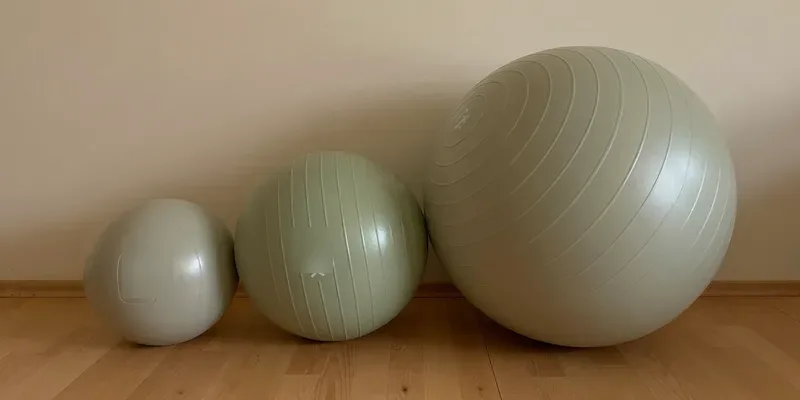
Ball diameters come in three practical sizes for pregnancy, and manufacturers map them to height bands. The bands below are the pattern those charts share, rounded to the nearest useful cutoff. Where a brand’s own chart disagrees with this one, follow the brand’s chart, because it is matched to how firm that particular ball inflates.
| Ball size | Height band | Seated check | Notes |
|---|---|---|---|
| 55 cm | Up to about 5 ft 3 in (160 cm) | Feet flat, hips just above knees | Feels low for average heights |
| 65 cm | About 5 ft 3 in to 5 ft 8 in | Most common correct fit | The default if you are unsure |
| 75 cm | About 5 ft 8 in and taller | Knees clearly below hip line | Also the carpet workaround |
| 85 cm | Rare, very tall frames | Hard to find in anti burst | Check ceiling and doorway storage |
Height bands vary between manufacturers, and reputable sellers publish their own chart on the listing. Trideer, one of the larger sellers of pregnancy balls, splits its bands slightly differently from the pattern above, which is exactly why the seated check matters more than any single table.
The Check That Beats the Chart
Inflate the ball, sit on the middle of it with your feet flat on the floor and your knees roughly hip width apart, and look at the line from hip to knee. Your hips should be level with your knees or slightly higher. Knees higher than hips means the ball is too small for you or not inflated enough.
Manufacturers describe the same target as roughly a right angle at the knee. If you are between two sizes and the seated check is borderline, go up rather than down, because a slightly large ball can be run a little softer while a small ball cannot be made taller.
Why Underinflation Fakes a Sizing Problem
A new ball stretches. Fill it most of the way, leave it for a day, then top it up to the stated diameter. Plenty of people conclude they bought the wrong size when what they actually have is a correctly sized ball sitting two or three centimeters short of its full height.

How to Measure the Ball, Not the Box
The number on the box is the diameter at full inflation, and almost nobody inflates to full. Measure it instead: stand the ball against a wall, mark the top of it with a piece of tape, and measure from the floor to the tape. That measurement is your real ball size.
Do this before you sit on it rather than after. It takes a minute, it tells you whether you have another inch of air to add, and it is the only way to know whether a soft ball is a sizing issue or an inflation issue.
Floors, Carpet and Where the Ball Lives
Where you put the ball changes the effective size. A thick carpet or a plush rug lets the ball settle into the pile, which lowers your hips by an inch or more. On carpet, people who are borderline between two sizes are usually happier with the larger one.
Hard floors do the opposite: the ball keeps its full height, and the issue becomes grip rather than size. A matte, textured shell holds on tile and wood, and a stability ring stops it rolling away entirely, which is worth having if you are getting on and off it many times a day.

Sizing for Different Uses
As a Desk Chair
Match the ball to your desk, not only to your height. Sit at the desk on the inflated ball and check that your forearms are roughly level with the desk surface. Someone at the top of a height band with a low desk is often better off at the smaller size.
For Leaning Over Rather Than Sitting
Leaning forward over a ball on the floor while kneeling wants a slightly larger ball, because a small one puts your chest almost on your knees. If leaning is the main reason you want one, size up rather than down.

For Use in Bed
A round ball does not work in bed, which is what the peanut shape exists for. Peanut balls are sized on a different scale entirely, from around 40 cm up to 70 cm, and Premier Birth Tools, which supplies many US hospitals, publishes its own height guidance for them. See our peanut ball guide for that side of it.
Frequently Asked Questions
What size birthing ball for 5 ft 4 in? 65 cm on almost every manufacturer chart. Confirm it with the seated check once inflated, and add air if your knees sit higher than your hips.
Should I size up if I am between two sizes? Yes. A slightly large ball can be run a little softer, while a ball that is too small can never be made taller no matter how hard you pump it.
Does the ball need to be rock hard? No. Firm enough that you do not sink in, with a slight give under your weight. Overinflating past the stated diameter puts stress on the seams and makes the ball unpleasant to sit on.
My ball feels smaller than the box says. Is it faulty? Usually it just needs topping up after the material has stretched. Measure floor to top against a wall and compare to the stated diameter before you assume it is a defect.
Can I use the same ball after the birth? Most people do, as a seat and as somewhere to bounce gently while holding a baby. Sizing does not change, though you may want it slightly firmer once you are standing up from it more often.
Is a bigger ball safer? Size is about fit, not safety. What matters for safety is the anti burst construction and the stated weight rating, both of which are printed on the listing.
If sitting upright is uncomfortable in a way that goes beyond finding the right height, or you have hip or pelvic discomfort that is getting worse, raise it with your midwife, OB-GYN or a pelvic floor physical therapist rather than working through it with a different ball.
The Bottom Line
Start with the brand’s own height band, buy 65 cm if you are genuinely unsure, inflate in two stages, and then confirm with the hip above knee check. Read next: the full birthing ball guide for anti burst ratings and grip, and what people actually do on the ball once it is inflated.