Last updated: August 23, 2026
They turn up on the same product pages, in the same bundles, in the same class handout, and it is easy to read that as two versions of the same thing. They are not. One is for being upright and one is for lying down, and buying the wrong shape for what you actually plan to do is the most common mistake in this small corner of the category.
This page puts them side by side: what each one physically does, where each one fails, and which one you probably want if you are only buying one. Neither of them is a technique, and neither of them changes how a birth goes. They are seats and supports.
This article contains affiliate links. If you buy through them, we may earn a commission at no extra cost to you. Learn more.
Quick Answer
Birthing ball or peanut ball, which do you need?
- Birthing ball if you want something to sit on, lean over and use every day at home. That is the one that earns its space.
- Peanut ball if you are thinking specifically about positions lying down in bed, where a round ball simply rolls away.
- They are not interchangeable. The shapes exist for different postures, and neither substitutes for the other.
- Ask your hospital before buying a peanut. Many labor and delivery units keep them; almost none lend you a ball for the months beforehand.
Bottom line: buying one, buy the round ball. Buying for a specific bed position, buy the peanut.
What Is Actually Being Compared
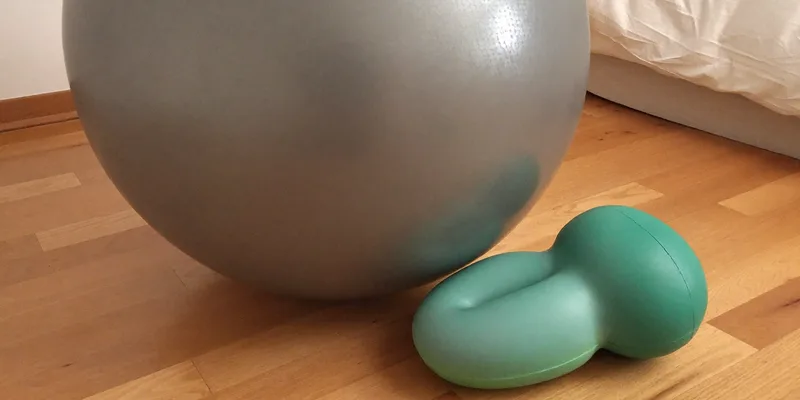
A birthing ball is a large round inflatable ball, usually 55, 65 or 75 cm, that you sit on with your feet flat or lean over from a kneeling position. A peanut ball is a smaller, waisted ball, usually 40 to 60 cm at the middle, that sits between or under your legs while you are lying down. Different geometry, different posture.
The round shape needs your body to balance on top of it, which is fine standing beside a bed and impossible lying in one. The peanut shape needs no balance at all, which is why it works in a hospital bed and why it is nearly useless as a chair.
Where Each One Wins
The round ball wins on daily use. It becomes a desk chair, an evening seat, a thing to lean over when standing has stopped being comfortable, and afterwards a place to sway gently while holding a baby. It gets used for months, which is not something you can say about most gear in this category.
The peanut wins in exactly one setting: lying on your side, where it holds the top leg so your hips stay open without you holding them there. It also packs smaller, deflates flat, and is easier to clean, which is why hospitals stock them rather than round balls for bedside use.
Where Each One Fails
A round ball in a hospital bed rolls off, and a round ball on a slick floor rolls away from you, which is the complaint that ends most birthing ball ownership. A peanut ball used as a seat is unstable and the wrong height, and a peanut bought in the largest size ends up unused because it pushes the top leg too high.
Side by Side
| Feature | Birthing ball | Peanut ball | Which matters |
|---|---|---|---|
| Shape and sizes | Round, 55 to 75 cm | Waisted, 40 to 70 cm | Peanut sizes run smaller |
| Main posture | Sitting upright, leaning over | Lying on your side | Decides which you buy |
| Everyday use at home | Chair, seat, lean support | Very little | Ball wins on months of use |
| Usually at the hospital | Sometimes | Often | Call and ask before buying |
Both are sold in anti burst construction with a stated weight rating, and both should be inflated to the diameter the manufacturer lists rather than to feel.
Which One Are You Buying For
You Want Something for the Next Three Months
Round ball, sized on your height. This is the one that replaces the couch in the evenings and the desk chair during the day, and it is the one people describe using constantly rather than occasionally.

You Are Packing for a Hospital Birth
Ask the unit what they keep. If they have peanut balls and allow their use, you do not need to carry one. If you want your own anyway, a mid size peanut deflates flat and takes almost no room in the bag.

You Are Planning a Home Birth or a Birth Center
Then you are the equipment, and both shapes are worth having. The round ball covers upright positions and leaning; the peanut covers side lying on a bed. Ask your midwife which she expects to use, because she may bring her own.
You Mostly Want Help Sleeping
Neither. A peanut between the knees is a poor overnight solution and a round ball is no help at all in bed. That job belongs to a wedge or a full length pillow, and our pregnancy pillow guide covers the shapes.
Avoid These Two Mistakes
The first is buying a bundle. Ball and peanut sets look like value and frequently pair a correctly sized round ball with a peanut in the wrong size, or the other way around. Sizing works differently for the two shapes, so buy them separately and size each one properly.
The second is buying a peanut before calling the hospital. It is a two minute phone call, the answer is often that they have a rack of them, and the same money spent on a properly sized round ball buys you months of use instead of a few hours.
What Neither of Them Does
Neither shape is a method and neither changes the course of a birth, and you should be wary of any listing that suggests otherwise. They are positioning tools that make certain postures easier to hold. That is a real and useful thing, and it is also the whole thing.
If you have questions about positions, about what is possible with monitoring in place, or about anything to do with pain or timing, those go to your midwife or OB-GYN. We keep the common at home questions in one place in what to know about what people try at home.
Frequently Asked Questions
Can a peanut ball replace a birthing ball? No. A peanut is the wrong height and shape to sit on, and it is unstable as a seat. They are two tools for two postures and neither covers the other’s job.
If I can only buy one, which? The round birthing ball, for almost everyone. It gets used for months at home, while a peanut is used in one setting that your hospital may already have covered.
Do the sizes match up between the two? No, and this trips people up. A 65 cm round ball and a 65 cm peanut are sized on different measurements, so use each maker’s own chart rather than carrying a number across.
Are the ball and peanut bundles worth it? Rarely. The sizes are chosen for the bundle rather than for you, and one of the two usually ends up wrong.
Can I use either one after the birth? The round ball, commonly, as a seat. Ask your provider before sitting on a ball if you have had a C-section or any repair.
Which one do hospitals use more? Peanut balls are the more common bedside item on US labor and delivery floors. Policies about bringing your own vary, so ask your unit directly.
Anything in this comparison that touches on comfort, positions or pain during labor is a conversation for your midwife or OB-GYN rather than a decision to make from a product page.
The Bottom Line
Round for upright, peanut for lying down, and no overlap between them. If you are buying one thing today, buy the round ball in your height band; if you are packing for a hospital birth, phone the unit first. Read next: the birthing ball guide and the peanut ball guide.