Last updated: August 23, 2026
The first time you feed a baby in public without a nursing top, you learn what the product is for. A regular shirt has to come up, which means your whole middle is out while you are also holding a person who has opinions. A nursing top has an opening that gives access to one side and leaves everything else where it was.
Which opening you choose is the entire decision, and the honest answer is that some of them are much better in the shop than they are at eleven at night with one hand free. This guide goes through the four main mechanisms, what a double layer top does, and which of these keep getting worn once the newborn stage is over.
This article contains affiliate links. If you buy through them, we may earn a commission at no extra cost to you. Learn more.
Quick Answer
Which nursing tops are worth buying?
- Double layer lift up tops are the easiest one handed and the most discreet, because the outer layer stays down.
- Crossover and wrap fronts are fast and comfortable but can gape if you are moving around.
- Hidden zippers look best under structured clothes and are the fiddliest in the dark.
- Buy tops that look like normal tops. The ones people keep wearing are the ones nobody can identify as nursing wear.
Bottom line: start with two double layer tops, add a wrap style, and skip anything you cannot open with one hand.
The Four Opening Mechanisms
Nursing tops open in one of four ways. Double layer designs have an inner panel that lifts while the outer layer stays down. Crossover fronts pull aside. Hidden zippers or snaps open vertically under a placket. Drop panels unclip from the shoulder, the same mechanism as a nursing bra.
All four give access. They differ in how discreet they are, how fast they open, and whether you need a second hand. That last one turns out to matter more than anything else on the label.
Double Layer Tops: the Reliable Default
A double layer top has a second inner layer across the front. You lift the outer layer, the inner layer stays down over your middle, and nothing but the feeding side is exposed. It works one handed, it does not require aiming, and it looks like an ordinary top from the outside.
The trade offs are heat and bulk. Two layers of jersey across the front is warmer than one, which is noticeable in summer and in the sweaty early weeks. Lighter versions exist and are worth the search if you are due in warm weather.
Why the Inner Layer Matters
The reason owners keep recommending this style is stomach coverage. In the first weeks your middle is still soft and tender, and having it uncovered in a cafe is what stops people feeding in public. An inner layer removes that entirely.

Crossover, Zipper, and Drop Panel
Crossover and wrap fronts are the fastest to open and the most comfortable in the early weeks, because nothing sits tightly across the chest. The weakness is coverage: a crossover that has been washed a few times gapes more than a new one, and it moves when you do.
Hidden zippers give the cleanest line under a fitted top and are the hardest to work one handed, especially the ones with a small pull tab. Drop panels are the most discreet of all and need two hands to unclip and re clip, which is the same mechanism as most nursing bras and has the same learning curve.
Fabric, Color, and Leaks
Leaking is unpredictable in the early weeks, and it dictates the sensible color palette: darker shades and busy prints hide it, plain pale colors do not. Textured knits also disguise a damp patch better than smooth ones.
Fabric weight matters for the same reason. A very thin jersey shows everything, including nursing pads. A mid weight cotton or modal knit drapes better, hides more, and survives the amount of washing this wardrobe gets. Look for something that goes in a normal wash at a normal temperature.
Nursing Tops by Situation
If You Want the Easiest Option in Public
A double layer t shirt in a dark color is what most people reach for first. One hand, no exposure, and it looks like a plain top from every angle.
If You Are Still Pregnant and Want Both
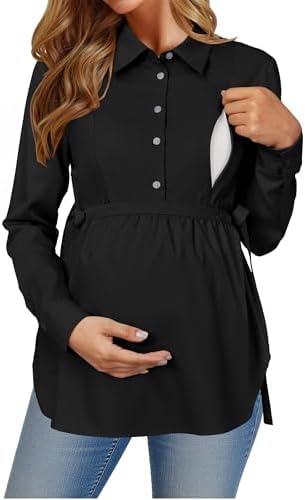
Maternity and nursing tops are cut long enough at the front to cover a bump now and open for feeding later, which makes them the best value in the whole category. Look for ruched sides that adjust as you change shape.

If You Need to Look Put Together
A hidden zip blouse reads as normal workwear and pairs with the rest of a work capsule, which our maternity workwear guide covers. Practice the zipper before the day you need it.
If It Is Cold
A long sleeve nursing top or a nursing sweater with a crossover front keeps your arms and back covered during a feed, which is the part people forget when they buy short sleeves in January.

The Four Openings Compared
| Opening | One handed | Discretion | Suits |
|---|---|---|---|
| Double layer lift up | Yes | High, stomach covered | Everyday and feeding in public |
| Crossover or wrap | Yes | Moderate, can gape | Early weeks and comfort |
| Hidden zipper | Difficult | High when closed | Work and structured outfits |
| Drop panel clips | No | Highest | Planned feeds, dressier tops |
If you only remember one column, make it the first. An opening you cannot work one handed is an opening you will stop using.
What Owners Complain About
Openings that need two hands come first, and the complaint is almost always about zippers and clips rather than the top itself. The second is tops that stopped fitting once the newborn stage passed, usually because they were bought in a maternity cut with a lot of extra front length.
The third is looking like nursing wear. Owners consistently keep the tops that pass as ordinary clothes and abandon the ones with visible flaps and contrasting panels. If feeding itself is uncomfortable rather than just awkward, that is a question for a lactation consultant or your midwife, not a clothing problem.
Frequently Asked Questions
Do I need nursing tops, or can I just lift a normal shirt? Plenty of people manage with normal shirts plus a stretchy tank underneath, which is the homemade version of a double layer top. Dedicated nursing tops mainly save you the layering and the guesswork.
Which opening is easiest at night? Double layer, because there is nothing to unfasten. Crossover is next. Zippers and clips are the ones people describe fighting with in the dark.
Should I buy maternity and nursing tops or nursing only? Combined maternity and nursing tops give you the longest wear, since they cover the bump now and open later. Nursing only cuts fit better once your body has settled.
What size do I buy? Your usual size in nursing only tops. In combined maternity and nursing tops, also your usual size, since the extra room is built into the cut rather than the sizing.
How many do I need? Three to five is the number most people land on, given how often tops get changed in the first weeks. Two double layer tops plus a wrap style is a good starting set.
Will they hide leaks? Darker colors and busy prints hide a lot more than pale plain ones, and nursing pads do the rest. A thin light jersey shows everything, including the pads.
The Bottom Line
Choose the opening you can work with one hand while holding a baby, in a color that forgives a leak, in a cut nobody can identify as nursing wear. Two double layer tops will cover more days than a drawer of clever mechanisms. Read next: the nursing bra guide for what goes underneath, and nursing nightgowns for the night version.