
Last updated: August 23, 2026
Almost every book written for the non pregnant person in a pregnancy assumes that person is a husband, and quite a few assume he finds the whole thing baffling. That leaves out a lot of people: non birthing mothers, partners who are not men, and anyone who would rather have a practical manual than a running joke about cravings.
This page covers the shelf for the supporting role more broadly. Some of it overlaps with the dad books, some of it is written specifically for families the mainstream titles skip, and one of it is simply the best manual for the delivery room regardless of who is holding it.
This article contains affiliate links. If you buy through them, we may earn a commission at no extra cost to you. Learn more.
Quick Answer
Which books are worth reading for a partner?
- A labor manual written for the support person is the single most useful book in the room.
- The mainstream guides are thorough but assume a father, which does not suit everyone.
- There are established titles written for non birthing mothers and queer families.
- One book about the first weeks at home matters more than a second pregnancy book.
Bottom line: buy the manual for labor first, then one book that speaks to your actual family.
What the Supporting Role Actually Needs
Three things, in order: knowing what happens during labor and what helps, knowing what to handle in the weeks around the birth, and having some language for a strange transition that nobody asks you about. Most books cover the first well, the second briefly and the third barely at all.
That ranking is worth keeping in mind while shopping, because the books that market themselves hardest to partners are usually strongest on general pregnancy information, which is the part the pregnant person is already reading.
Who These Books Are For
Anyone who will be in the room, whether that is a spouse, a partner, a sister or a friend. The role is the same and the reading list is the same, which is why the best title in the category is named after the job rather than after a relationship.
The Manual for the Room
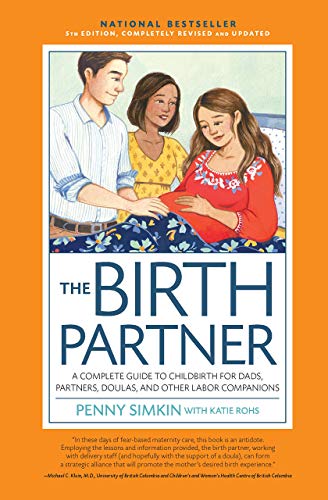
The Birth Partner by Penny Simkin is written for the support person and organized as a working manual: the stages of labor, what tends to happen in each, what to do, what to say and when to step back. Doulas and childbirth educators use it as a reference, and it does not assume any particular relationship or gender.
It is dry, thorough and completely practical, which is exactly right for a book you may end up consulting while something is happening. If you buy one book for a partner, this is the defensible choice.
The Mainstream Guide, With Its Assumption Named
The Expectant Father by Armin Brott and Jennifer Ash Rudick is the most complete month by month guide written from the supporting side, and it is genuinely useful on the practical and emotional preparation. It is also written throughout for a father, which some readers find fine and others find alienating.
If the framing does not bother you, it is the strongest general option. If it does, the titles below cover similar ground without the assumption. Our books for dads page covers the rest of that shelf, including the shorter and funnier handbooks.

Books for Non Birthing Mothers and Queer Families
Two established titles come up repeatedly. Confessions of the Other Mother, edited by Harlyn Aizley, is a collection of first person pieces by non biological lesbian mothers, and it is the book people recommend for the specific experience of being a parent whose role nobody has a script for.
Stephanie Brill’s The New Essential Guide to Lesbian Conception, Pregnancy, and Birth is the practical counterpart, covering the process from conception onward for lesbian couples and single women, including the parts mainstream guides leave out.

Beyond the Pregnancy Itself
Brill’s The Queer Parent’s Primer is broader, dealing with navigating schools, paperwork, family and institutions as an LGBTQ family rather than with pregnancy specifically. It is a longer horizon book, and it tends to be read after the birth rather than before.

Choosing by What You Need
| What you need | Type of book | Typical pick | Read it |
|---|---|---|---|
| To be useful during labor | Practical manual | The Birth Partner | Late pregnancy, then during |
| To follow the whole pregnancy | Month by month guide | The Expectant Father | Throughout |
| To see your own family reflected | Essays or a targeted guide | Titles written for queer families | Any time |
| To survive the first weeks | First weeks guide | A postpartum book | Before the birth |
Most partners need the first row and one other, and which other depends entirely on the family.
The Part Partners Are Least Prepared For
The weeks after the birth are where a supporting partner does the most and reads the least. Practical books about that period cover food, rest, visitors and dividing the nights, and reading one in advance is what turns good intentions into an actual arrangement.
Our postpartum books guide covers the shelf, and the recovery kit page covers what to have in the house. If feeding is part of the plan, breastfeeding books are worth a skim by the partner too, since knowing how it is supposed to work makes support easier.
Frequently Asked Questions
Do partners really need their own book? Not need, but the labor manual earns its place because it is written to be used rather than read. The rest is optional.
Are the dad books usable by anyone? Content wise mostly yes, framing wise not always. If the constant address to a husband would irritate you, choose a title written for the role rather than the relationship.
What if I am supporting a friend or sister rather than a spouse? The Birth Partner is written exactly for that and does not assume a couple. It is the standard recommendation for doulas for the same reason.
Is there anything written for adoptive or surrogacy situations? There is, and it is a distinct shelf with its own legal and practical content, so look for titles specific to your route rather than adapting a pregnancy guide.
Should the partner read the pregnancy reference too? Skimming it is enough. Our main books guide covers which reference suits which reader.
What if I am worried about how I will cope? Worth saying out loud to your own doctor rather than reading around. Books are for orientation and this is not a reading problem.
Books prepare a partner for the role, not for anything clinical. Questions about this pregnancy or this birth belong with the midwife or OB-GYN.
The Bottom Line
Start with the manual written for the support role, then add one book that reflects your actual family rather than the default one. Add something about the first weeks and the partner is better prepared than most. Read next: the dad specific shelf and the full pregnancy books guide.