Last updated: August 23, 2026
Hands free is a promise about your life rather than about the garment. It means answering an email during a session, eating with two hands, or holding a baby who is not the one being pumped for. Once you have done a week of pumping while holding two flanges in place, that promise is worth paying for.
There are two ways manufacturers deliver it, and they are genuinely different products sold under one phrase. One is a bra with the pump openings built in. The other is a band you pull on over the bra you are already wearing. Which one suits you depends less on your body than on where and how often you pump.
This article contains affiliate links. If you buy through them, we may earn a commission at no extra cost to you. Learn more.
Quick Answer
Which hands free pumping bra should you choose?
- All in one bras are faster: unclip, insert, pump, and you never change garments.
- Over the top bands hold more firmly and fit a wider size range, at the cost of a minute each session.
- Pumping at work usually favors an all in one, because the change of clothes is what eats the break.
- Pumping at home or overnight usually favors a band, because holding power matters more than speed.
Bottom line: choose by where you pump. Speed wins in an office, grip wins on the sofa at two in the morning.
The Two Designs
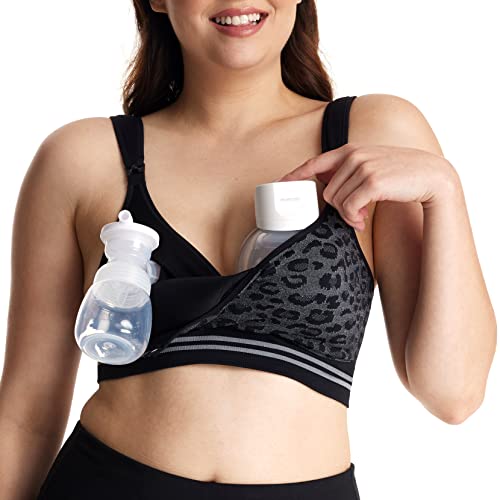
An all in one hands free bra is a nursing bra with reinforced openings in the front panel, so it can be worn all day and switched to pumping in seconds. An over the top band is a strapless sleeve of firm fabric with a wide adjustable back closure, worn over your own bra only while you pump.
The difference in holding power comes from where the tension is set. In an all in one, the fabric decides how firmly the flange is held, and fabric relaxes over time. In a band, you decide, and you can tighten it again next month.
What Both of Them Are Not
Neither design makes a badly sized flange work, and neither turns a stretchy sleep bra into a pumping bra. If flanges keep slipping, the cause is usually diameter, band tension or weight rather than the category of bra, which our guide to pumping bras and flange fit works through in order.
Pumping at Work Changes the Math
A workday pumping session has a fixed budget and most of it goes on logistics: finding the room, setting up, packing down, washing parts. Anything that removes a step is worth more than anything that improves comfort by a small margin, which is why all in one bras dominate among people who pump at the office.
The bra you wear to work also has to look like a bra under a shirt. A molded cup hands free bra with the openings hidden in the seam solves both problems at once and is worth the extra money if you pump on workdays.
Hands Free Bras by Situation
The picks below map onto the four routines that come up most often. If you fall between two of them, buy the one that matches your busiest situation, since that is the one where the bra either works or annoys you.
Best if you pump between meetings
An all in one hands free and nursing bra in a plain cotton blend is the workhorse of this category: clips for feeding, openings for flanges, comfortable enough to wear from morning to evening. Buy two so one can be in the wash without the routine falling apart.

Best if you want it invisible under a shirt
A molded cup hands free bra keeps a normal bra shape under work clothes and hides the pump openings in the seams. It holds slightly less firmly than a dedicated band, which is a fair trade when the alternative is changing clothes in a shared room.

Best if holding power is all that matters
The strapless band worn over your own bra is still the firmest hold in the category, because a wide hook and loop closure lets you set the tension precisely and reset it as the fabric ages. It also spans a very wide size range, which makes it the safest buy while your size is still settling.

Best if you use a wearable pump
Wearable pumps do not need an opening, they need depth and a firm band to stay upright as they fill. A seamless hands free bra with fixed padding gives you both, and it doubles as an ordinary bra on the days you do not pump.
All in One Against Over the Top
| Design | Setup time | Holding power | Suits |
|---|---|---|---|
| All in one, soft | Seconds | Moderate | All day wear, frequent short sessions |
| All in one, molded cup | Seconds | Moderate | Workdays, fitted clothing |
| Over the top band | About a minute | Firmest | Long sessions, exclusive pumping |
| Seamless wearable pump bra | Seconds | Depends on band fit | In cup pumps |
Setup time is the number people underestimate and holding power is the one they overestimate, so weigh both against your own week rather than against a review.
Living With One
Hands free bras wear out faster than ordinary bras because the fabric is repeatedly stretched around something rigid. Washing cool and drying flat extends that life considerably, and putting a bra through a hot dryer is the fastest way to lose the grip that makes it work.
Owning two is the other practical answer. Pumping is a daily routine, milk and moisture get on everything, and a single bra means washing at inconvenient times. Two is enough for almost everyone, and a third only helps if you pump several times a day away from home.
Comfort Over Long Sessions
A hands free bra is firm by design, and firm garments get uncomfortable over long stretches. Loosen or remove it between sessions rather than wearing a band all day, and choose a wider underband if you get pressure marks. If anything feels sore rather than simply snug, ask a lactation consultant to look at both the bra fit and the flange fit.
Frequently Asked Questions
Is a hands free bra the same as a pumping bra? Hands free describes what it does, and it covers both the all in one bras and the over the top bands. Every hands free bra is a pumping bra; not every pumping bra is genuinely hands free, since some still need you to steady the flange.
Can I wear an all in one hands free bra all day? Yes, that is the point of the design. The soft cotton versions are comfortable enough for a full day, and the openings sit flat when nothing is in them. Molded cup versions are the ones to wear under work clothes.
Do I still need a separate nursing bra? Not necessarily, since all in one models include nursing clips. Most people who pump daily still keep a soft sleep bra for nights, because pumping bras are too firm to sleep in.
Will one fit me now and after my size settles? An over the top band will, because its adjustable closure covers a wide range. An all in one is sized like an ordinary bra and will need replacing if your size moves. Our guide on how to measure explains when your measurements are worth trusting.
Can I pump both sides at once in any of these? Yes, double pumping is the normal use case for all of them. What varies is how well each side stays put when the bottles get heavy, which is where the over the top band pulls ahead.
Are they worth it if I only pump occasionally? One is. Even occasional pumping is more pleasant with both hands free, and a single all in one bra covers the odd session without changing anything else in the drawer. Start with the pumping bra guide if you are not sure how often you will use it.
The Bottom Line
Choose by where you pump. An all in one saves a change of clothes and wins on workdays; an over the top band holds hardest and wins for long or exclusive pumping; a seamless firm cup is the answer for wearable pumps. Buy two, wash them cool, and expect the fabric rather than the design to be what eventually gives up. Read next: the full pumping bra guide and why flanges slip and how to stop it.