Last updated: August 23, 2026
It starts as a dull line across the lower back around four in the afternoon. By the third trimester it is there when you get out of the car, when you load the dishwasher, and when you stand at the kitchen counter for longer than it takes to make toast. Reviewers describe it in almost identical words: everything is fine until I have been upright for a while, and then my back is done.
A support belt is the product people reach for, and it is worth being precise about what it does. It changes how the bump’s weight is distributed while you wear it. That is a comfort function. It is not a treatment, it is not a plan, and it does not replace having the ache looked at by someone who can examine you.
This article contains affiliate links. If you buy through them, we may earn a commission at no extra cost to you. Learn more.
Quick Answer
Does a belly band do anything for a sore lower back?
- A structured support belt takes some of the forward pull off your lower back while you are wearing it, which many pregnant people find makes standing and walking more comfortable.
- A soft seamless band does almost nothing for load. If your reason is your back, you want the belt, not the band.
- Free changes first: how you stand, how you get out of bed, where you sit, and how you sleep, since a side sleeping setup often matters more than any belt.
- Back discomfort in pregnancy has several possible causes, so a belt is something to try alongside advice from your provider, not instead of it.
Bottom line: a structured belt is a reasonable comfort tool for a heavy bump. It is not an answer to why your back hurts.
Why the Ache Shows Up in the Afternoon
As the bump grows forward, the body compensates by shifting posture, and the lower back does more of the holding. That is why the discomfort is so often cumulative rather than sudden: it arrives after hours of being upright and eases when you lie down. Owners describe the pattern more consistently than almost anything else in this category.
It also explains why a belt can make a difference to how the day feels. Move part of the load onto the hips and the back is doing less of the work for those hours. When the belt comes off, everything returns to normal, which is exactly what you should expect.
Start With the Things That Cost Nothing
Before buying anything, change the cheap variables. Break up long periods of standing. Put one foot on a low step when you have to stay in one place. Get out of bed by rolling to your side first. Sit with your back supported rather than perched forward on the edge of a chair.
Sleep is the other free lever, and it is the one people underestimate. Side sleeping with support between the knees keeps the hips and lower back in a straighter line all night, which is the whole argument for a pregnancy pillow for back discomfort and for the broader pregnancy pillow guide.
Why the Structured Belt Is the Right Shape Here
A soft stretch band solves clothing problems. It has no rigid element, so it cannot carry weight, and buying one for a heavy bump is the most common mismatch in this category. A structured belt has a firm underbelly panel and hip straps, which is the design that actually redistributes load.
The panel sits low, under the bump and against the top of the pubic bone, with the strap resting on the hip bones. Fastened higher it presses on the belly and slides within minutes. That single placement detail separates most of the good reviews from the bad ones, and it is covered step by step in how to wear a belly band.
Belts Worth Looking At
The Simple Underbelly Belt
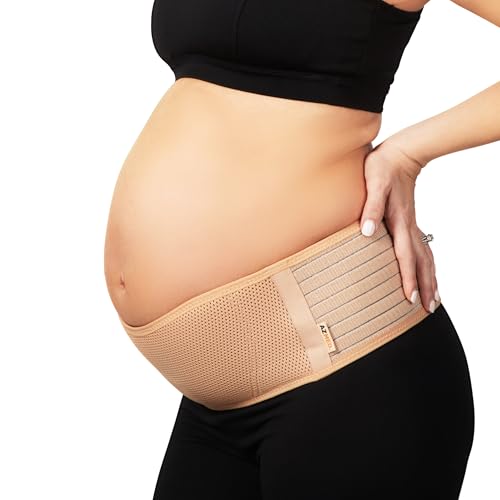
One shaped panel, one broad strap, nothing to learn. AZMED’s maternity belt is the most bought version of this design by a wide margin, and it is the sensible first belt for a bump that has simply become heavy.
Wider Support Across the Back
If a narrow strap concentrates everything into one line across your back, a belt with a broader rear panel spreads it out. Gabrialla’s elastic maternity support belt is built that way and offers more adjustment range as your shape changes through the third trimester.
When Heat Is the Deciding Factor
Every belt is an extra compressive layer, and in summer that is often what makes people stop wearing one. NeoTech Care’s pregnancy support belt uses less material and a more breathable panel, which is the usual trade for slightly less firmness.

Support Without a Strap Across the Back
A wrap sets its tension across a wide overlap rather than one band, which some owners find easier to tolerate for longer stretches. Belly Bandit’s Upsie Belly is the common example of that approach.

The Options Compared
| Option | Where the load goes | Comfort in heat | Suits |
|---|---|---|---|
| Simple underbelly belt | Hips, via one strap | Moderate | First belt, heavy bump |
| Wide back panel belt | Spread across lower back | Lower, more material | Long days upright |
| Lightweight belt | Hips, slimmer panel | Best | Summer, low bulk |
| Wrap style | Even, wide overlap | Moderate | Dislike of a defined strap |
None of the rows is a treatment column, because none of these products offers one.
What Owners Say Goes Wrong
The most common complaint is that the belt slid down and stopped doing anything, which is nearly always placement or a size too large. The second is heat. The third is expectation: people who bought a belt as a solution rather than as a comfort tool tend to describe it as useless, while people who bought it to get through a shift describe the same product as essential.
There is also a quieter pattern worth naming. A belt that is fastened extremely tight does not work better, it just becomes unwearable and presses where it should not. Snug enough to hold, loose enough to breathe, and readjusted through the day is what owners who keep using theirs describe.
Frequently Asked Questions
Will a belly band make my back stop hurting? No product can promise that, and this one certainly cannot. What a structured belt does is take some of the bump’s forward pull off your lower back while it is on, which many pregnant people find makes standing and walking easier to get through.
Band or belt for back discomfort? Belt. A soft seamless band is a clothing product with no structural element, so it cannot redistribute weight. The difference is laid out in band versus belt.
How tight should it be? Snug enough that it stays in place when you walk, loose enough that you can breathe normally and slide a finger under the strap. If it leaves deep marks or makes you lightheaded, it is too tight.
Can I wear it while sleeping? Manufacturers generally describe these as daytime products for activity. For nighttime the more useful purchase is usually a support pillow that keeps you comfortable on your side.
What if the ache is sharp or on one side? That is a different situation from general heaviness, and it deserves a proper look rather than a product. Speak to your midwife or a pelvic floor physical therapist before spending money on gear.
When to Ask a Professional Instead
Back discomfort in pregnancy has more than one possible cause, and a belt does not distinguish between them. Talk to your midwife, your OB-GYN, or a pelvic floor physical therapist if the ache is severe, one sided, worsening, radiating down a leg, coming in waves, or accompanied by anything else that worries you. A physical therapist can also tell you whether a belt is a sensible part of your particular situation, which is a better use of the question than any review.
The Bottom Line
If your reason for searching is a heavy bump and a tired lower back, buy the structured belt rather than the soft band, fasten it low, and treat it as one comfort tool among several. Change the free things first, sort out how you sleep, and get the ache looked at if it is more than tiredness. Read next: maternity support belts for the full buying view, and the belly band guide for the category overview.