
Last updated: August 23, 2026
Sizing a belly band is a strange exercise, because you are buying for a body that will not stay the same for more than a couple of weeks. Order for today and it may be tight by next month. Order for later and it does nothing at all right now, which is the version people complain about most.
The way out is knowing which of the two product types you are sizing. One is engineered to be adjusted across a wide range and you buy it once. The other is sized like clothing and gets outgrown. Confusing them is behind most of the returns.
This article contains affiliate links. If you buy through them, we may earn a commission at no extra cost to you. Learn more.
Quick Answer
What size belly band should you buy?
- Measure under the bump, where the belt will actually sit, not at your natural waist.
- Adjustable one size belts cover a wide span, so buy for now and let the hook and loop follow you.
- Sized soft bands run to a chart, and reviewers routinely advise going up a size.
- Check the manufacturer’s own measurement range before trusting a generic S, M, L label.
Bottom line: measure under the bump today, buy adjustable if you want one purchase to last.
Measure Where the Band Will Sit
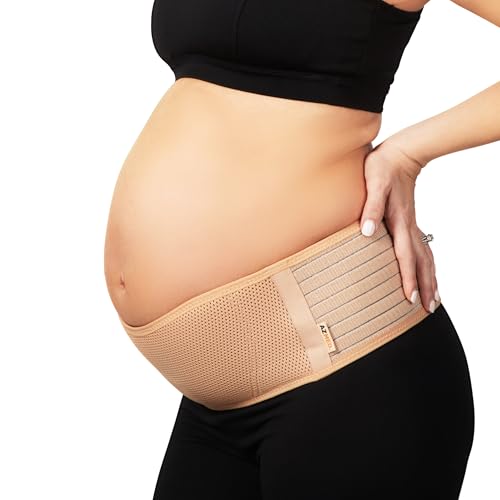
A support belt sits low, under the bump, so that is where the tape goes. Stand up, let everything settle, and measure around your hips at the level where the belt will actually rest. Measuring at your natural waist, or over the widest point of the bump, produces a number that has nothing to do with the fit.
Write the number down along with the date. Bumps change, and having a starting measurement makes it obvious later whether the belt is genuinely too small or has just been closed badly. Our guide to positioning a band covers the fitting side.
Adjustable One Size Belts
Structured support belts are usually sold as one size with a wide adjustment range, because the hook and loop closure is doing the sizing work. AZMED, for example, lists its maternity belt as an adjustable one size design fitting up to a stated waist measurement, which is why the same belt tends to last from the second trimester to the end.
The catch is at the small end rather than the large one. If your under bump measurement is well below the bottom of a belt’s stated range, the closure runs out of overlap in the wrong direction and the panel bunches. Check both ends of the published range, not just the maximum.
What to Do If You Are Near the Top of the Range
Sitting near the upper limit at twenty weeks means you will pass it before the end. Look for a model sold in more than one size, or one that offers an extension panel, rather than buying the one size version and hoping. Our article on plus size belly bands covers the ranges that go further, and bands for twins covers growing out of things early.
Sized Soft Bands and the Size Up Question
Soft seamless bands are sized like clothing, often as S/M and M/L rather than single sizes. KeaBabies, for instance, sells its maternity belly band in lettered sizes with an adjustable hook and loop section. Because these are knitted rather than engineered, the fit is closer to buying a garment than buying equipment.
Sizing up is the standard reviewer advice across this whole category, and it is usually right for the same reason it is right for nursing bras: the fabric relaxes with wear, and a band at the very top of its stretch loses its shape fastest. A band that is slightly generous still works. One that is stretched to its limit rolls at the edges and quits.

When the Size Is Right and It Still Feels Wrong
Before deciding the size is wrong, check three things: whether the wide panel is centered on your spine, whether you closed it standing rather than sitting, and whether you are wearing a soft band while expecting the behavior of a structured belt. All three produce a fit complaint that is not a sizing problem.
Digging at the hip edges is a shape mismatch rather than a size mismatch. Narrow belts concentrate their pressure on a small area, and on a shorter torso that lands right on the hip bone. A wider back panel, or a model with a contoured edge, solves what going up a size will not.
How the Sizing Systems Compare
| Product | How it is sized | Measure | Buying approach |
|---|---|---|---|
| Structured support belt | One size with a published range | Under the bump, standing | Buy for now, check both ends of the range |
| Multi size support belt | S, M, L by measurement chart | Under the bump, standing | Use the brand’s chart, not a generic one |
| Soft seamless band | S/M, M/L like clothing | Pre pregnancy size as the starting point | Size up if you are between sizes |
| Belly support briefs | Standard underwear sizing | Hip measurement | Buy your usual size in a maternity range |
Measurement ranges vary between brands, so use the chart published for the exact model rather than a general pregnancy sizing table.
Buying Twice on Purpose
Some people size deliberately for two stages: a lighter band now and a structured belt later, when the bump is heavier and standing is harder. That is a reasonable plan rather than a failure of planning, and it costs less than replacing a stretched out band that never fit properly.
If you only want one purchase, the adjustable belt is the one that spans the most time. Owners consistently report that the adjustable models stay in rotation longest, simply because there is always another notch of hook and loop available.

Frequently Asked Questions
Do I size on my pre pregnancy size or my current one? Structured belts are sized on your current under bump measurement, taken standing. Soft seamless bands are usually sized from your pre pregnancy clothing size, with the brand’s chart as the tiebreaker.
Should I size up? For soft knitted bands, yes if you are between sizes, since the fabric relaxes and a band at full stretch loses shape fastest. For adjustable belts there is nothing to size up into, so check the published range instead.
Will one band last the whole pregnancy? An adjustable belt usually will if your starting measurement is not near the top of its range. A sized soft band often will not, which is worth knowing before you buy the expensive one early.
What if I am between two sizes on the chart? Go up for soft bands and stretch fabrics. For a structured belt with two sizes, pick the one where your measurement sits in the middle of the range rather than at either edge.
Does the same size work after birth? Not reliably, and postpartum wraps are a different product anyway. Our article on postpartum versus pregnancy bands explains why they are not interchangeable.
The size is right but it hurts. What now? Take it off. A correctly sized band should feel held, never pinched, and discomfort that persists is worth raising with your midwife, OB-GYN, or a pelvic floor physical therapist rather than solving with a different size.
Fit advice here is about a garment, not about your body. If wearing a correctly sized band is uncomfortable, or if the discomfort you bought it for is sharp, one sided, or getting worse, speak to your midwife, your OB-GYN, or a pelvic floor physical therapist.
The Bottom Line
Measure under the bump while standing, use the chart for the exact model rather than a generic one, and buy adjustable if you want a single purchase to see you through. Size up on soft knits, and check the low end of the range on one size belts. Read next: choosing between the two types and wearing it so it stays put.