Last updated: August 23, 2026
Most belly bands arrive without instructions worth reading. There is a picture of a smiling woman on the packaging, a strip of hook and loop, and no clue about whether the thing goes over your bump, under it, over your shirt, or against your skin. Plenty of people put it on once, decide it feels wrong, and leave it in a drawer.
The good news is that wearing one correctly is mostly about three decisions: where it sits, how snug you close it, and whether you are wearing a soft band or a structured support belt. Those two products look similar in a listing and behave completely differently on a body.
This article contains affiliate links. If you buy through them, we may earn a commission at no extra cost to you. Learn more.
Quick Answer
How do you wear a belly band?
- A structured support belt sits low, under the bump, with the wide panel across your lower back.
- A soft seamless band sits over the bump and works as a layer of clothing more than as support.
- Snug enough to feel held, loose enough to slide two fingers under the edge.
- Follow the wearing instructions on the packaging of your own model, since they differ by brand.
Bottom line: put the support under the bump and the soft band over it, and adjust while you are standing, not sitting.
First, Work Out Which One You Own
Two very different products sell under the same search term. A maternity support belt is stiff, narrow at the front and wide at the back, and closes with hook and loop. A belly band is a soft seamless tube of stretchy fabric with no closure at all. Wearing one like the other is the single most common mistake.
If yours has a rigid back panel and adjustable straps, treat it as a belt. If it pulls on over your feet or over your head like a tube top, treat it as a band. Our guide to belly bands versus maternity belts covers what each one is actually built to do, and the main belly band guide covers picking between them.
Where a Support Belt Sits on Your Body
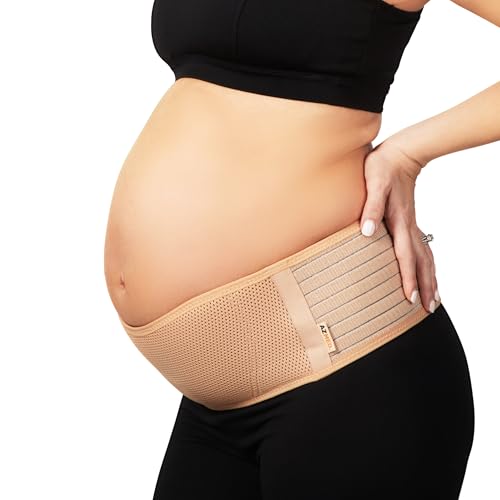
A support belt goes low. The narrow front section passes underneath the bump so that the belly rests on top of it, and the wide section wraps your lower back. Worn high, across the middle of the bump, it presses on the belly instead of carrying it and tends to roll upward within minutes of walking.
The easiest way to get the height right is to stand up, let the bump settle, and slide the front panel down until it sits in the crease where the bump meets your hips. Close it there. AZMED describes its belt as adjustable across a range of waist measurements, which is what lets the same belt keep working as your shape changes.
Getting It On Without Help
Most belts are easier to fasten from the front. Center the wide panel on your lower back first, bring both ends around, and close the inner layer before the outer strap. If your model has a second overlapping strap, that one is for fine tuning, so leave it loose on the first pass and tighten it once you are standing straight.
Over or Under Your Clothes
A structured belt goes over a thin layer, not against bare skin. A cotton tank or a fitted tee stops the hook and loop from catching skin, keeps sweat off the belt, and makes it far easier to slide into position. A soft seamless band can go either way, though most people wear it as a clothing layer.
The soft band earns its keep bridging a gap. Worn over the waistband of unbuttoned pre pregnancy jeans, it holds them up and covers the gap so you can keep wearing the trousers you already own. That is a wardrobe function rather than a support function, and it is worth knowing which one you paid for.
How Tight Is Tight Enough
Snug, never squeezing. You should feel gently held and be able to slide two flat fingers between the band and your body. Your breathing should not change and the edges should not leave deep marks. If you loosen the belt every time you sit down, it is too tight standing up.
Adjust standing, because everything shifts when you sit. Many people find they want it a notch looser in the evening than in the morning, and a notch looser again after a meal. That is normal, and it is why the adjustable models tend to stay in use longer than the fixed ones.
The Two Finger Check
Do the check at the front and at the back. A belt that passes the check at the front but not across the lower back is usually sitting crooked rather than being the wrong size. Straighten the back panel, recenter it on your spine, and close it again before you decide the size is wrong. Our sizing guide covers what to do when it genuinely does not fit.
When It Rides Up, Rolls, or Digs In
Riding up almost always means the belt started too high. Rolling at the top edge usually means the fabric is being stretched past its comfortable range, which points to a size rather than a technique problem. Digging in at the hips is a sign the belt is narrow for your build or closed too tightly.
Heat is the other complaint that shows up constantly in owner reviews, especially in summer and for anyone on their feet all day. A mesh panel band breathes noticeably better than a laminated one, and wearing it over a thin cotton layer helps more than people expect. If your day involves long shifts, our article on wearing a band at work goes into that specific problem.

The Two Wearing Styles Side by Side
| Product | Where it sits | Worn with | What it is doing |
|---|---|---|---|
| Structured support belt | Low, under the bump, wide panel on the lower back | Over a thin top, under outerwear | Carrying some of the bump’s weight |
| Soft seamless band | Over the bump and the waistband | As a visible clothing layer | Bridging clothes, light gentle compression |
| Belt plus band together | Belt low, band pulled over the top | Belt hidden under the band | Support without the belt showing |
| Postpartum wrap | Across the abdomen after birth | Against skin or over a thin layer | A separate product, see below |
The third row is the trick nobody puts on the packaging: a soft band pulled over a support belt hides the hook and loop and stops the belt edges from showing through clothes.
Keeping It Wearable
Hook and loop dies if you let it. Close the strap onto itself before it goes in the wash, wash on a gentle cycle in a mesh bag, and air dry rather than tumble dry, because heat is what makes the elastic go slack. A belt that has lost its grip is not repairable and is the usual reason people replace one mid pregnancy.
Two bands are more practical than one if you wear it daily, simply so there is always a dry one. Owners consistently report that the second one gets bought around the point where the first is being washed every other evening.

Frequently Asked Questions
Should the belt go over or under the bump? Under. A structured support belt is designed so the bump rests on top of the front panel, which is how it takes some of the load off your lower back. A soft seamless band is the opposite and is meant to sit over the bump as a layer.
Can I wear it over bare skin? You can, but most people find a thin cotton layer underneath much more comfortable, and it keeps the hook and loop away from skin. It also keeps the belt cleaner, which matters if you are wearing it most days.
How do I stop it rolling down when I walk? Start lower than feels natural, close it while standing, and check that the back panel is centered on your spine. Persistent rolling after that usually means the band is being stretched near the top of its size range rather than being worn wrong.
Can I wear it in bed? Manufacturers generally write their wearing instructions for daytime activity, so follow the guidance that came with your model, and ask your midwife or a pelvic floor physical therapist if you are considering wearing one overnight. For comfort in bed, a pillow between the knees is the more usual answer.
Do I wear the same band after birth? Usually not. Postpartum wraps are a separate category with a different shape and a different purpose, which our article on postpartum versus pregnancy bands explains.
It still feels wrong. Now what? Check the size before you blame the product, then check the type. A soft band will never feel like support, no matter how you wear it, because it was not built to give any.
If wearing a band correctly still leaves you uncomfortable, or if the discomfort is sharp, one sided, or getting worse, that is a conversation for your midwife, your OB-GYN, or a pelvic floor physical therapist rather than a shopping decision.
The Bottom Line
Work out which of the two products you own, put the structured belt low and the soft band high, close it standing up, and keep two fingers of room. Everything else is fine tuning. Read next: belly band versus maternity belt if you are still choosing, and how long to wear one each day.