Last updated: August 23, 2026
Search for a hospital bag and you will find a thousand lists of what to put in one, and almost nothing about the bag itself. That is not an oversight. There is no such thing as a hospital bag as a product category: what people actually buy is a weekender, a carry on roller or a backpack, and the hospital is simply the first trip it takes.
Which is good news, because it means you are choosing an ordinary travel bag you will keep using for years rather than a single use item. The decision comes down to four things: how the bag moves through a hallway, how it behaves in a small room, whether the dirty clothes can be kept separate, and who is carrying it while also carrying a car seat.
This article contains affiliate links. If you buy through them, we may earn a commission at no extra cost to you. Learn more.
Quick Answer
Which bag should you use as a hospital bag?
- A medium weekender duffel with a separate bottom compartment suits most people.
- A carry on roller if you are packing for a longer stay and would rather not carry anything.
- A backpack for the partner, so both hands stay free for the car seat.
- A hanging toiletry bag in whichever of them you choose, because hospital bathroom shelves are tiny.
Bottom line: buy a travel bag you would use for a weekend away, not something branded for this one occasion.
Why There Is No Winning Hospital Bag Product
Look at what sells and the pattern is obvious: generic weekenders, ordinary toiletry bags and diaper bag backpacks. Nothing is engineered for a maternity unit, because nothing needs to be. A hospital stay is a short trip with awkward timing, and short trip luggage already exists.
That reframes the purchase usefully. Instead of asking which bag is right for the hospital, ask which travel bag you are missing from your house. Buy that one, use it for this, and keep using it afterward.
The Features That Do Matter
Three things separate a bag that works in a hospital room from one that annoys everybody. A wide opening so nothing has to be excavated. A separate bottom compartment for shoes and dirty clothes. And a shape that sits on a chair without falling over when it is half empty.
The Weekender Duffel
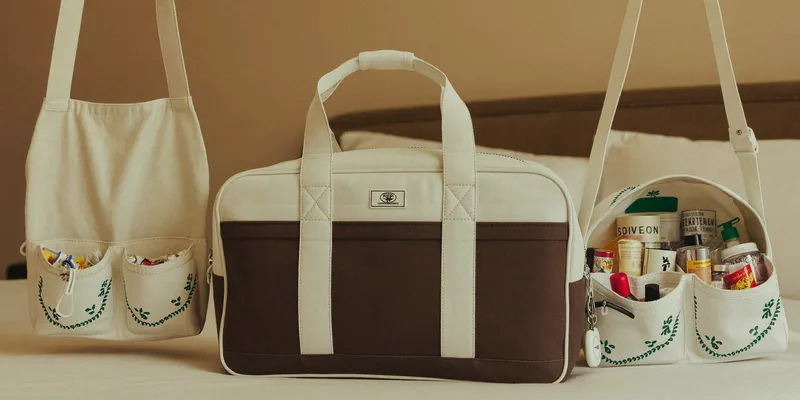
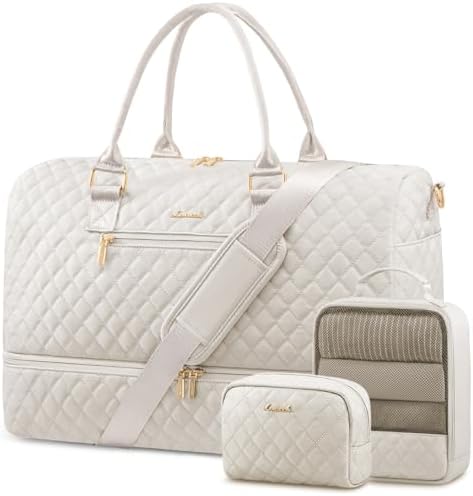
This is the shape most people end up with, and for good reason. A medium duffel holds a realistic amount, opens flat so you can see everything at once, and can be carried on a shoulder while your other hand has something else in it. It also stores flat when it is not in use.
The feature to look for is the separate compartment underneath. It was designed for shoes and it turns out to be the ideal place for the clothes that need washing, which is otherwise the thing that contaminates a whole bag by the second day.
If You Want One Bag That Does Everything
A medium weekender with a bottom compartment and a trolley sleeve is the most flexible option here, and the sleeve means it rides on a roller if you own one.
The Carry On Roller
A small wheeled case is the option for a longer stay or for anyone who would rather not carry weight. It rolls through a parking garage, it stands upright in a corner, and it protects anything fragile inside without any thought.
The trade off is space. A hard shell case needs floor room to open, and a hospital room is a small room with a lot of equipment in it. People who use a roller tend to keep it in the car and carry a small pouch of daily items into the room, which is a sensible split whatever bag you buy.
If the Stay Is Likely to Run Long
A soft or hybrid carry on with a wide opening is easier to work out of in a cramped space than a rigid clamshell that has to lie fully flat.

The Backpack and the Diaper Bag
A backpack solves one specific problem better than anything else: the person carrying the bag also has to carry an infant car seat, and a car seat is a two hand item in practice. Both straps on the shoulders keeps everything possible in one trip.
Diaper bag backpacks are the usual pick because they have the insulated side pockets and the organized front panel, and they carry on afterward as the everyday bag. They are smaller than a weekender, which suits the partner bag rather than the main one.
For the Partner, or as the Second Bag
A diaper bag backpack works as the room bag and becomes the daily bag afterward, which is the strongest argument for spending anything at all on it.

The Shapes Compared
Four options, judged on how they behave in a small room rather than on capacity alone.
| Bag type | Handles well | Weak point | Suits |
|---|---|---|---|
| Weekender duffel | Wide opening, bottom compartment | Carried, not rolled | Most people, most stays |
| Carry on roller | No weight to carry, stands upright | Needs floor space to open | Longer stays, garage parking |
| Diaper bag backpack | Hands free with a car seat | Smaller capacity | Partner bag, second bag |
| Tote or gym bag | You already own one | No separation, slides off shoulders | The car bag |
The Toiletry Bag Is the Real Upgrade
Hospital bathrooms have a small wet counter and often no shelf at all. A hanging toiletry bag with a hook solves that completely, keeps everything visible, and means a partner can find your toothbrush without asking. It is the item people mention as an unexpected favorite.
Look for a hook that swivels, a clear or mesh section so you can see what is inside, and a size that still fits in the main bag. Full size bottles are the enemy here, since the counter space that does exist gets used for other things.
The Small Buy That Improves the Whole Stay
A hanging organizer costs little, works in every hotel bathroom afterward, and removes one daily irritation from a stay that has enough of them.

Organizing Whatever Bag You Pick
The bag matters less than what is inside it being findable. Group items into pouches by when you need them: admission paperwork and chargers in one, your clothes in another, baby clothes in a third, and the going home outfits in a fourth that can stay in the car until discharge.
Packing cubes are the cheap way to do this, and they double as the answer to the perennial problem of a partner being sent to find one specific thing. Our hospital bag checklist lists what goes in each group, and the skip list covers what does not need a pouch at all.
Color Coding Without Overthinking It
Three cubes is enough: yours, the baby’s, and the going home set. Anything more and the system becomes the thing you have to remember.

Frequently Asked Questions
Is there a bag specifically made for hospital stays? Not meaningfully. What sells for this purpose is ordinary travel luggage, which is why we recommend buying a bag you will use again rather than one branded for a single occasion.
How big should the bag be? Carry on size or smaller for the room bag. If you cannot lift it onto a chair with one arm, it is too big, and a second bag in the car is the better answer than a larger one inside.
Can I just use a gym bag I already own? Yes, especially as the car bag. The features you miss are the separate bottom compartment and a wide opening, both of which matter more on day two than on day one.
Duffel or roller for a planned C-section? A roller, because the stay is usually longer and you will not be lifting bags. Our C-section packing guide covers what else changes.
Do we need a bag each? One each works better than one shared, and the partner bag can be small. Our partner bag guide covers what goes in it.
When should the bag be packed and by the door? Earlier than feels necessary, since the timing is not up to you. Our guide to when to pack walks through a simple two stage approach.
The Bottom Line
Buy the travel bag you are missing rather than a hospital bag. A medium weekender with a bottom compartment covers most stays, a carry on roller suits a longer one, a backpack keeps the partner’s hands free, and a hanging toiletry bag is the small upgrade that everyone notices. Read next: what goes in it and the mom bag.